

Last week I wrote about why parts of the industrial stack need to be rebuilt from the ground up. But zooming in on warehouse operations, the more immediate opportunity isn’t a clean-slate rebuild, it’s an orchestration layer that helps fragmented systems talk to each other. The distinction is that in some parts of the industrial world, legacy systems are so rigid that the only path forward is a rebuild. In others, like warehouses, the bigger problem is fragmentation, and the fastest path to value is orchestration.
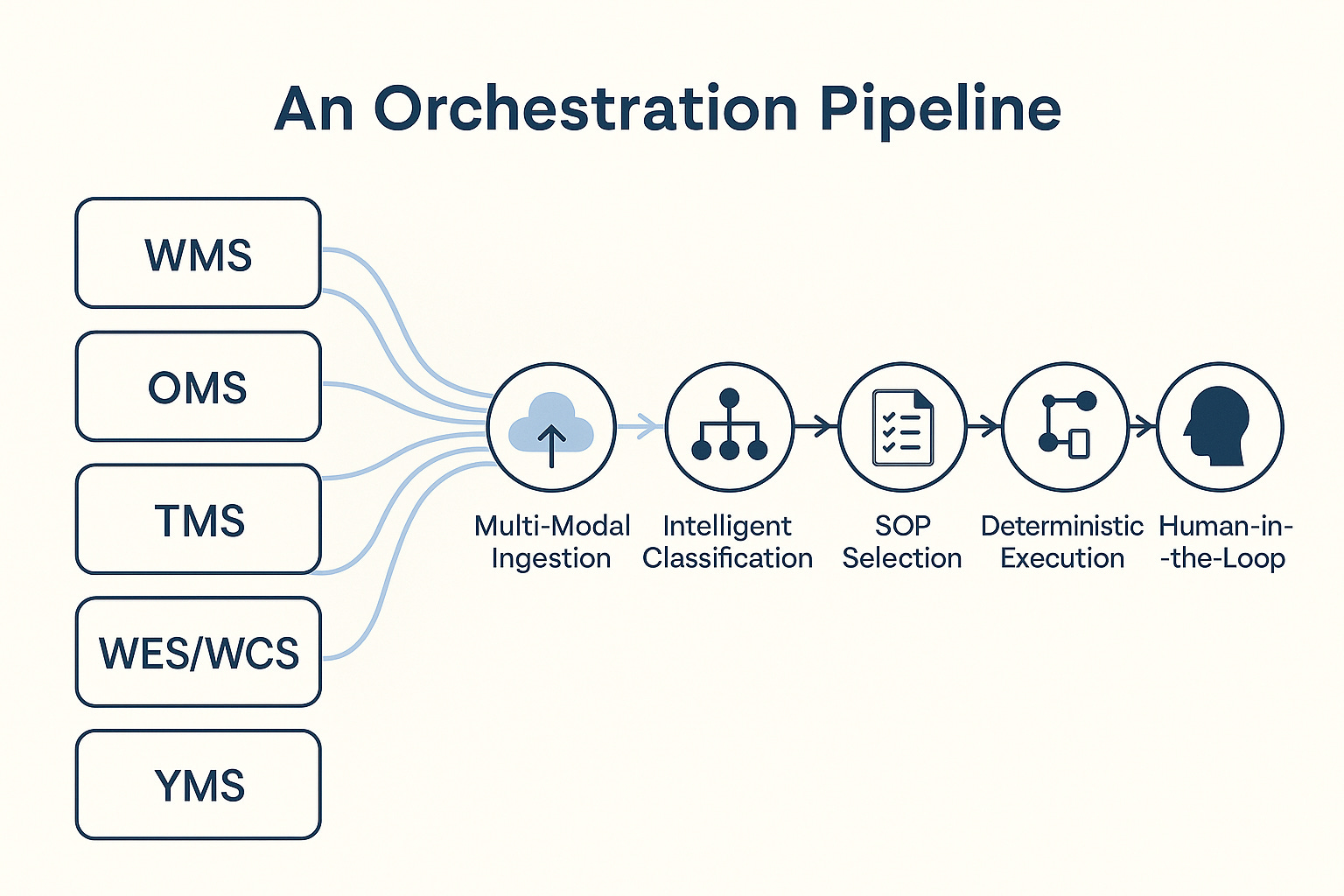
Modern warehouses run on a patchwork of systems that rarely speak the same language. A typical warehouse juggles:
WMS (Warehouse Management System)
OMS (Order Management System)
TMS (Transportation Management System)
Vendor/carrier portals
WES/WCS (Automation controls)
YMS (Yard Management System)
I’ve heard stories of some facilities even running two entirely separate WMS instances, one for raw materials and another for finished goods. This forces operators to navigate multiple systems just to track a single item’s journey through the warehouse.
Because these systems don’t talk to each other cleanly, there is fractured visibility and inefficient decision-making. This means that “simple” tasks (resend PO, file claim, fix BOL, inventory mismatch) trigger multi-party workflows, forcing operators to coordinate across disconnected views.
This strain created a gap that gave rise to “warehouse orchestration,” a concept that has only emerged in the past few years as a response to systems that could no longer keep up.
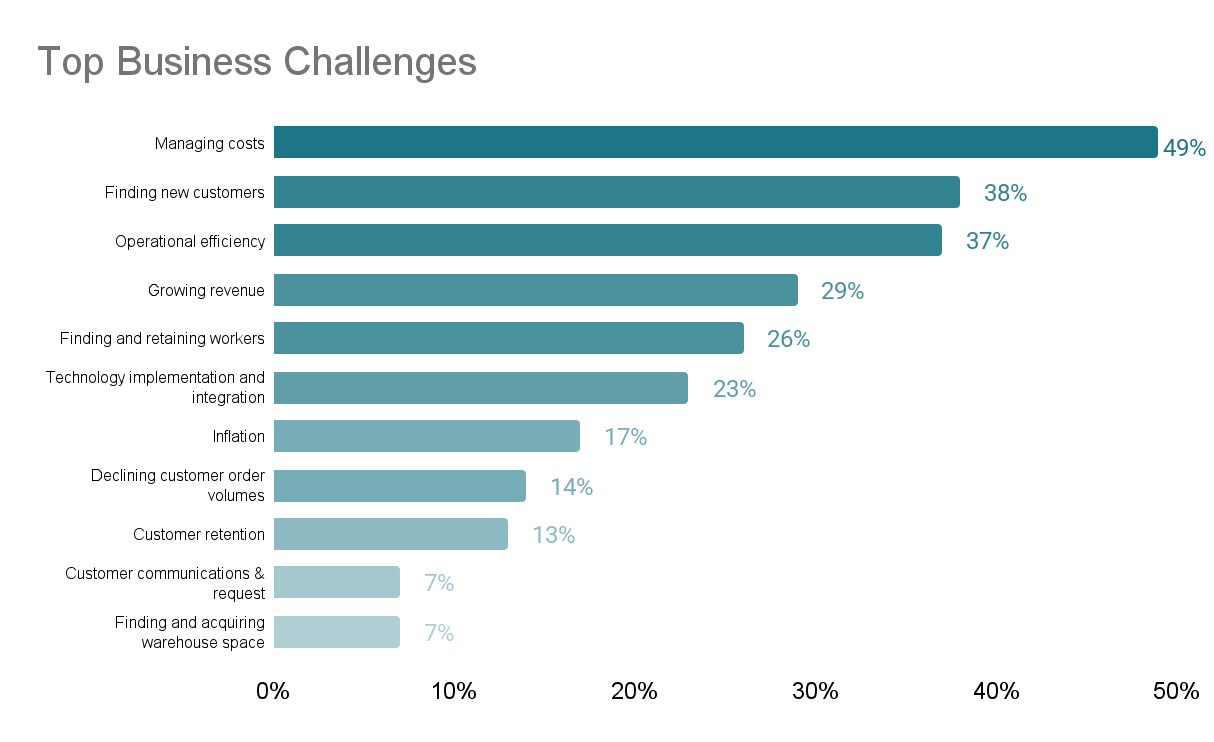
Warehouses now have dedicated orchestration teams, which rely heavily on human workforces (think: planners, schedulers, exception managers, and call-center reps) to manually reconcile mismatched data between WMS, TMS, ERPs, and carrier portals. This overhead eats into already-thin margins (warehouse gross margins typically hover around 8-12%). In fact, a recent survey by Extensiv of logistics professionals who own or operate third-party logistics (3PL) warehouses found that managing costs was their top challenge, with operational efficiency ranking close behind. This underscores just how critical orchestration and automation have become for maintaining margin and scale.
Building an Orchestration Layer
Because modern fulfillment and warehouse environments are so fragmented, the AI-native opportunity isn’t (at least initially) to replace any single system. Instead, it’s to create an orchestration layer that sits above the existing systems, thereby unifying signals, automating actions, and continuously learning.
An orchestration pipeline could look like this:
1. Multi-Modal Ingestion: pulling structured and unstructured signals from transactional systems (WMS, OMS, TMS, ERPs), communication platforms (email, SMS, chat logs, support tickets, WhatsApp for international markets), and external partner platforms (EDI alerts, carrier portals, vendors systems).
The goal here is to centralize everything into one real-time feed.
2. Intelligent Classification: using context-aware AI to detect intent and urgency behind each event. Similar issues are clustered automatically, reducing noise. For example, “Is this a delayed truck or a missing SKU?”, or “Is this a single mis-scanned item or a systemic picking error affecting an entire batch?”, or “Is this a one-off customer complaint, or does it signal a recurring issue across multiple zones?”
3. SOP Selection: matching issue type with operational context to create playbooks. For example, “late LTL pickup” might trigger updated dock assignments along with proactive customer comms.
4. Deterministic Execution: converting playbooks into automated workflows that would push updates across connected systems and execute clear decision trees where logic is well-understood. In other words, “clicks on your behalf” at scale.
Every action should be logged to create a full audit trail for SLA compliance, training, and process improvement.
5. Human-in-the-Loop: escalating edge cases or ambiguous events. Every human resolution feeds back into the model to continuously improve. Over time, fewer events require manual intervention.
Because the fulfillment stack is notoriously inconsistent, any orchestration layer would need two complementary integration paths:
API-first: Where modern APIs exist, direct connections into WMS/OMS/TMS work. This enables deep data access and pushes real-time commands natively.
Browser Operators: For legacy portals without APIs, autonomous browser agents log in, click, and input data just like a human would. This is especially important for carrier portals, vendor extranets, or outdated ERP modules.
The Data Flow Advantage
Not long ago, the phrase “warehouse orchestration” didn’t exist because it didn’t need to. But over the past decade, the warehouse has become a fragmented operating environment: one system (maybe more) to manage orders, another for inventory, another to route trucks, and a half-dozen more portals to coordinate vendors, carriers, and robots. These systems rarely speak the same language.
Teams are now drowning in alerts and manually bridging systems that were never designed to interoperate. I’ve heard some warehouse managers describe their day as “40% clicking, 40% following up, and 20% actual problem solving.”
As gross margins compress and SLA pressure mounts, warehouses have responded by staffing up with planners, exception handlers, and call center reps just to keep the operation glued together. But the glue is breaking down.
The orchestration layer is emerging to change that. Not by replacing the stack, but by tying it all together. The long-term future may demand reinvention, but right now, warehouse operators need relief without ripping out the entire stack.
Our original pitch deck basically had the same exact phrase, just exchaing warehouse for warranty: "Modern warehouses run on a patchwork of systems that rarely speak the same language. A typical warehouse juggles xyz:"