

Two years ago I was skeptical about how big of an impact AI could really have in manufacturing. This was because back then AI meant LLMs, which meant the inputs and outputs were text-based, and text is just a wrapper around work, but it’s not the work itself in any real sense when it comes to manufacturing.
But a lot has changed in two years. A lot has changed in the last couple months!
And to say I’m no longer bearish on what AI can do in manufacturing is an understatement. I’ve never been more excited about the opportunities I’m now seeing for AI to come in and change the way we build plants and products in the manufacturing world.
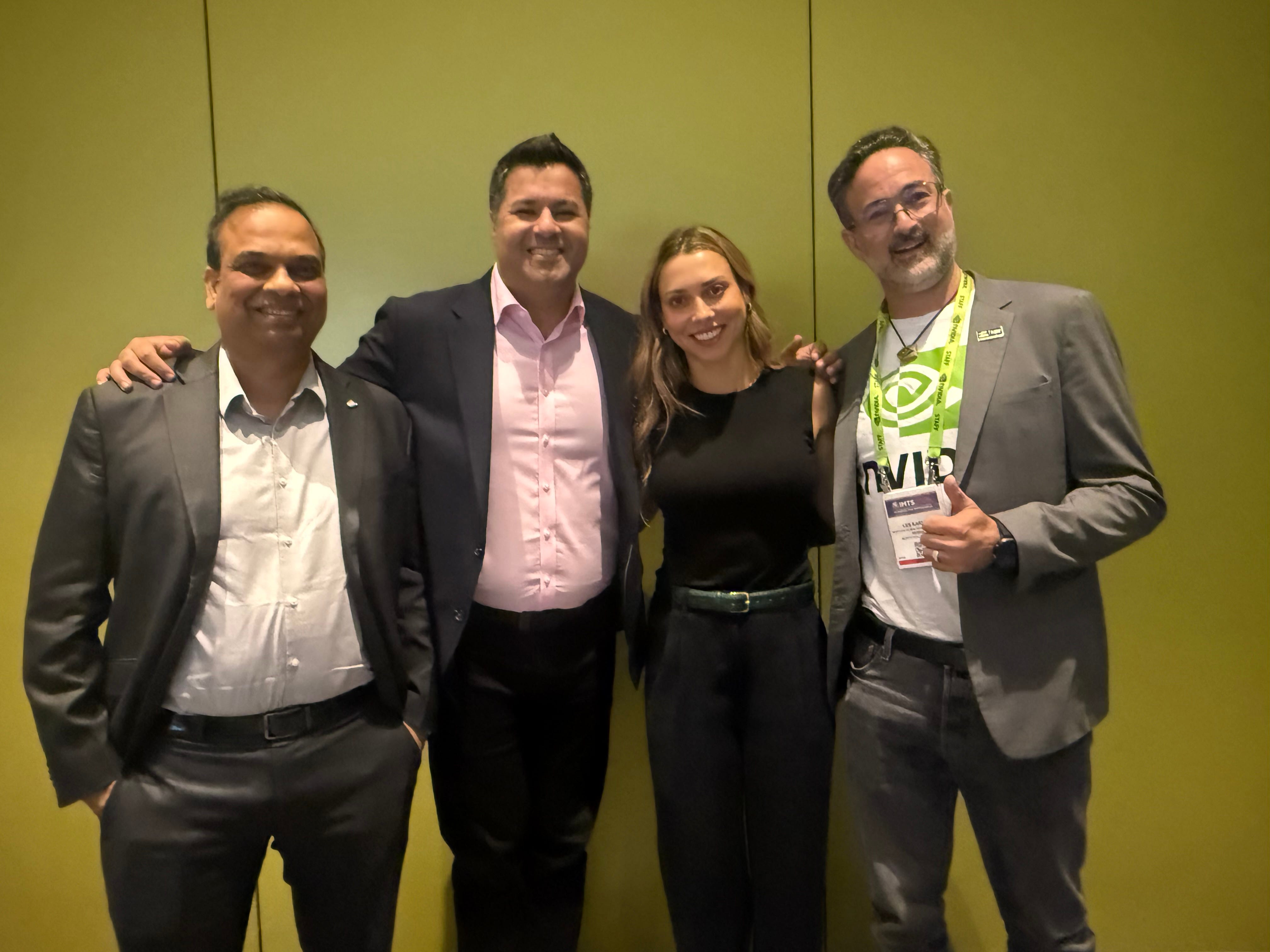
Last week I moderated a panel at IMTS about AI infrastructure in manufacturing with Praveen Rao (Global Head of Manufacturing at Google Cloud), Shiv Trisal (Global Lead for Industrials and Energy at Databricks), and Les Karpas (Global Head of Physical AI at NVIDIA Inception). Each of them has also had to rethink something fundamental about AI in manufacturing over the last couple years.
It’s no longer just about the model and chasing intelligence at any cost. The models have reached a point where they are smart enough for most jobs. The constraint is now shifting toward context and the infrastructure that takes the insights generated from AI to then produce a physical outcome.
Our panel dove into these topics and here are some of my takeaways.
From insights to action
The panel cautioned that agent activity for the sake of generating insights is not inherently productive.
Manufacturers have become inundated with alerts. So much so that they often can’t prioritize the ones that actually matter.
What is productive, however, is closing the loop from insight to action. Thus the metric of success shifts from number of workflows or tokens to number of end-to-end business resolutions.
This isn’t a new idea but it is a lot more complicated to execute in manufacturing plants than many other industries given the nature of a factory floor and the number of legacy systems, machines and humans having to interact.
The panel advised having three foundations in place in order to move from insight to action:
A unified data semantic across all the plant’s data.
An agentic platform with contract-based delegation to systems such as ERP and PLM.
Multimodal interfaces to allow for easier agent orchestration.
They also suggested starting narrowly with just one problem that you can’t solve today or can only solve slowly or manually. Then work backwards from there to understand what data is needed to solve that problem. From there, you can gradually expand to more problems.
Legacy equipment and the data problem
Machines on a factory floor tend to be decades old, at least. They also use hundreds of different PLC vendors and protocols. And some very old machines may not even have a PLC.
These systems weren’t built for interoperability and so the data they generate often needs to be supplemented with additional context around what the measurements mean and how they relate to a process. This has to happen before AI can effectively use the data. This is one of the reasons AI adoption in manufacturing has lagged.
The panel stressed the importance of creating a unified namespace or contextualized data layer that connects all of a plant’s different data, and preserves context across handoffs.
Also, physical AI doesn’t have the internet-scale training set that LLMs had. This means the data that is available needs to be stretched further in a sense so that you can improve digital twins and simulations and then generate synthetic data to validate policies. And once deployed into production, the real-world performance needs to be fed back into the system in order to generate a continuous flywheel.
AI can’t turn bad data into good data, so this work around establishing reliable context and quality is critical before any useful actions can happen reliably. Useful and reliable being key words here!
Own your data in open formats
Every few weeks, there’s a new model at the top of a leaderboard. As such, the need to own your data and context, and store it in open formats is now more important than ever. This is what allows you to easily switch between the best models and not lose any of the logic you’ve been building.
Openness matters at the tooling layer too. OpenUSD is an example of a common open format for physical AI. It’s a 3D wrapper that can bring together models, time-series, language, and OT data to improve interoperability across a system. Having a common wrapper format for the 3D, time-series and OT data is what lets different systems share one representation of the plant.
It’s a multi-AI system, not an LLM
A lot of value on a factory floor is still driven by traditional ML. And as such, the panel stressed the importance of making sure you’re applying the right kind of AI to a problem. This also ensures you don’t fall into the trap of token maxing instead of value maxing.
One example we talked about was predictive maintenance. In this case, ML is probably best for predicting equipment failures and forecasting demand for spare parts. Whereas an LLM is best for interpreting the training manuals. And a mathematical optimization model is best for scheduling work under various constraints.
We also talked about how agents are now writing ML, which means a forecasting model can be built in under a day without needing a large data science team. This is especially impactful for small and mid-sized manufacturers who previously didn’t have the resources to build some of these tools internally.
Edge and cloud, not edge or cloud
A combination of cloud and edge solutions is critical on factory floors.
Edge deployments are best for anything that requires very low latency or where regulatory concerns are an issue. The cloud is best for larger workloads like analyzing large volumes of data. It’s also where the learning loop happens because of the volume of data that’s needed across both the operational and business sides of a factory.
It’s no longer a binary choice. The panel recommended having a connected architecture.
Robotics and the case for and against humanoids
Robotics is unquestionably the next frontier of physical AI on the factory floor. But what is less clear is what the optimal form factor will be.
The built world, including manufacturing plants, has been designed with the human body in mind. It’s thus a very natural transition to go from humans that have two arms, two legs, and ten fingers to robots that also have two arms, two legs and ten fingers. Not to mention, we’ve recorded a lot of videos of humans doing tasks. Therefore, starting with a humanoid form factor makes sense to some extent because that’s where we have the data. Then you can use cross-embodiment to transfer the policies into other bodies.
The counter argument here is that we’ve become obsessed with the body and perhaps lost sight of the basics. What matters in the physical world is the ability to move things, to take action, reliably. And the form factor to do this depends on what exactly you’re trying to move or do. The question of form factor in the abstract doesn’t make sense; you have to start with what the job to be done is.
The adoption bottleneck
The biggest bottleneck to AI adoption in manufacturing these days probably isn’t capability. The models are largely good enough.
What’s missing is the data and context, and the real-world applications and feedback loops.
Two things make this hard. The data problem is a legacy of machines that were never designed to interoperate. The adoption problem is that factories are measured on throughput and uptime, and production can’t absorb the disruption that standing up AI creates.
I’ve never been more excited about the opportunities ahead for physical AI in manufacturing. But to unlock its potential, both problems need to get easier. On data, this probably means starting from the problem you’re trying to solve and wiring up only the minimum set of data required, in open formats, rather than modeling the whole plant first. On adoption, this probably means setting up controlled environments for testing and very gradual scale-up only after AI has proven it can resolve an end-to-end action rather than generating yet another alert.
IMTS is an incredible conference for those building or interested in manufacturing. I used to come to it as a founder when I was building Prima. It was fun to come back this year and get to see all that has changed and continues to change for the manufacturing world!
Author’s note: An LLM was used for light copy editing only (spelling, grammar, and clarity). Content, meaning, tone, and structure remain unchanged.