

Go on YouTube and search “toddler doing chores.” It’s a wholesome corner of the internet. You’ll find three-year-olds putting away dishes, folding laundry, and just generally trying to be as helpful as they can be. It’s astonishing to see how general-purpose toddlers are! If you give one a vague instruction like “put the cups away, sweetie,” they’ll try almost anything.
You would not, however, want to rely on their performance in any business setting. The cups end up in a pile (or worse!). The laundry has to get refolded. And in general, any task that takes an adult 30 seconds probably takes 10 minutes, if not more.
This is roughly the state of general-purpose robotics today: magical toddler-like generalizability, but also toddler-like reliability. The demos and generalization are impressive at first, but you wouldn’t want to run a factory on their performance.
Meanwhile, factories all over the world are full of the opposite kinds of robots. Like the palletizer that Formic installed for a mid-sized contract manufacturer packing everything from spices to cleaning pods. The person who used to do that job has, in a sense, been promoted to now doing work that actually needs human judgment. And nobody thinks about the palletizer anymore because they know it will do its one job at 99%+ reliability, around the clock, for years.
But that palletizer, like the millions of other industrial robots installed all over the world, is also so specialized that asking one to do literally anything else is a months-long engineering project, if it’s even possible at all.
Everyone in robotics (the humanoid startups, the foundation model labs, the industrial incumbents, and especially us) agrees on the destination: robots that are both broadly capable and production-reliable. But nobody agrees on how to get there. Between us, we’ve built robots, operated them in factories, and invested in the companies developing them.
We think we know how.
The Map
Here’s how we see the industry on a chart.
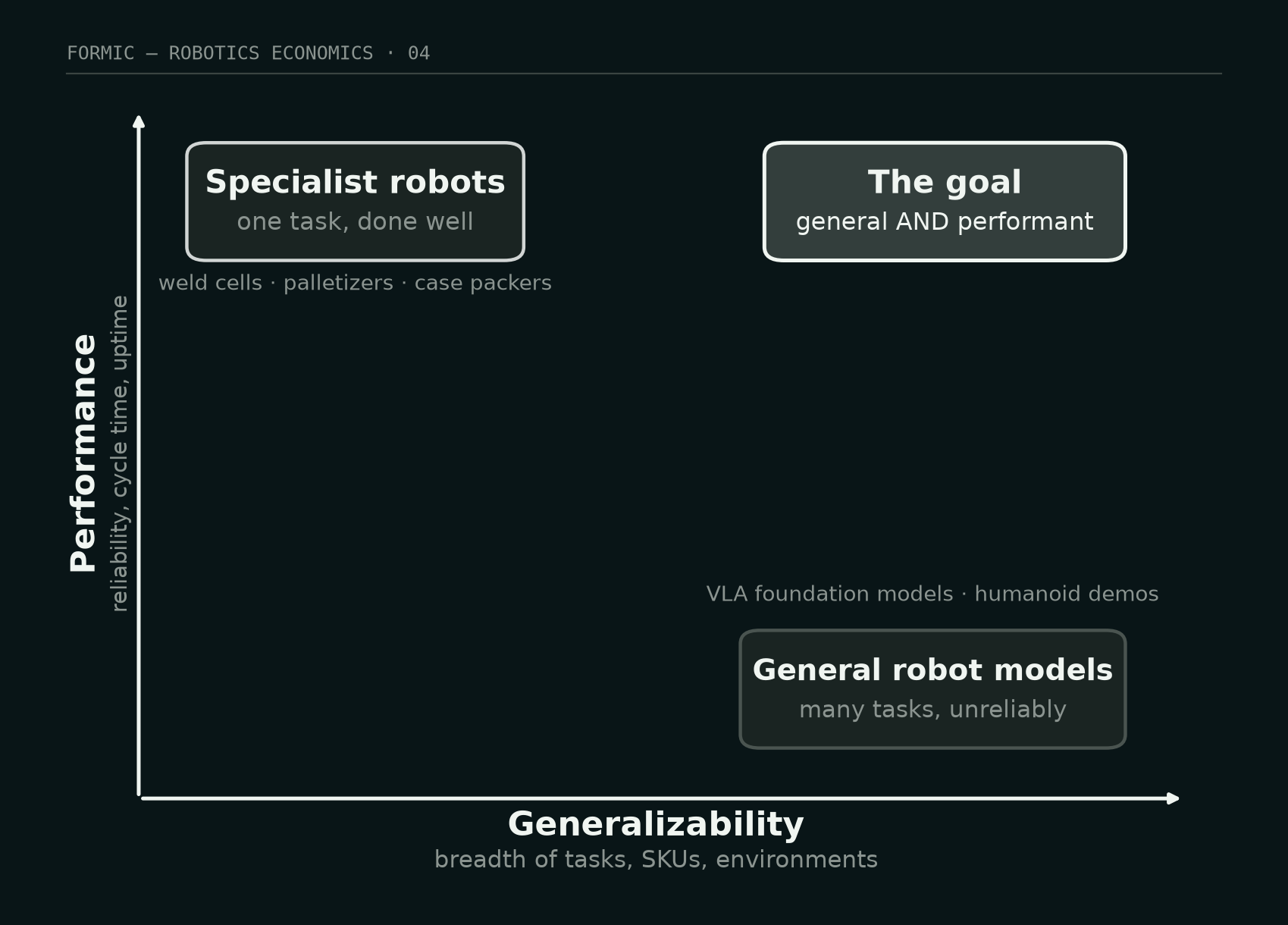
The vertical axis measures performance (reliability, cycle time, and uptime). This is basically how well the robot does its job in production. The horizontal axis measures generalizability: the range of tasks, products, and environments it can handle. And perhaps most importantly, the horizontal axis also measures how much work (programming, but also hardware like fixtures and conveyors) it takes to get a robot to do something new.
The top-left corner are the specialists. These include weld cells, palletizers, pick-and-place machines, etc. They’ve undergone decades of refinement, and their economic value is clear and proven. But they’re still incapable of doing anything other than the one thing they were built for.
In the bottom-right corner are the generalists. These are end-to-end robot foundation models, vision-language-action systems and their cousins that can attempt nearly anything you describe in a sentence. They can complete tasks at demo-grade success rates (think 70-90%), and they tend to look incredible on a launch video!
The top-right corner is the general and performant robot. This is the goal.
You don’t get to the top-right corner overnight. You have to traverse the map deployment by deployment, and every intermediate point on your path either generates revenue or burns cash. Robotics, after all, is capital-intensive; it’s an atoms-not-bits industry.
Why the Midpoints Matter More Than the Destination
In the same way AI changed the digital world, robotics will change the physical world. It’s going to create and capture trillion-dollar markets. We believe that as much as anyone: one of us runs a robot fleet, another runs a fund whose thesis is that AI will eat the world, and hardware is its teeth.
But conviction doesn’t fund a market like this. Sustained investment does, and venture capital alone isn’t enough. Somewhere along the way, you need value-creating, cash-flowing businesses.
So then, each point along the path of a robotics strategy matters a lot (versus just where the path ends). Some paths run through what we call a revenue corridor: every step is a product somebody will pay for today. Other paths run through a valley of death: every step is merely a milestone on the way to a future product, funded on faith.
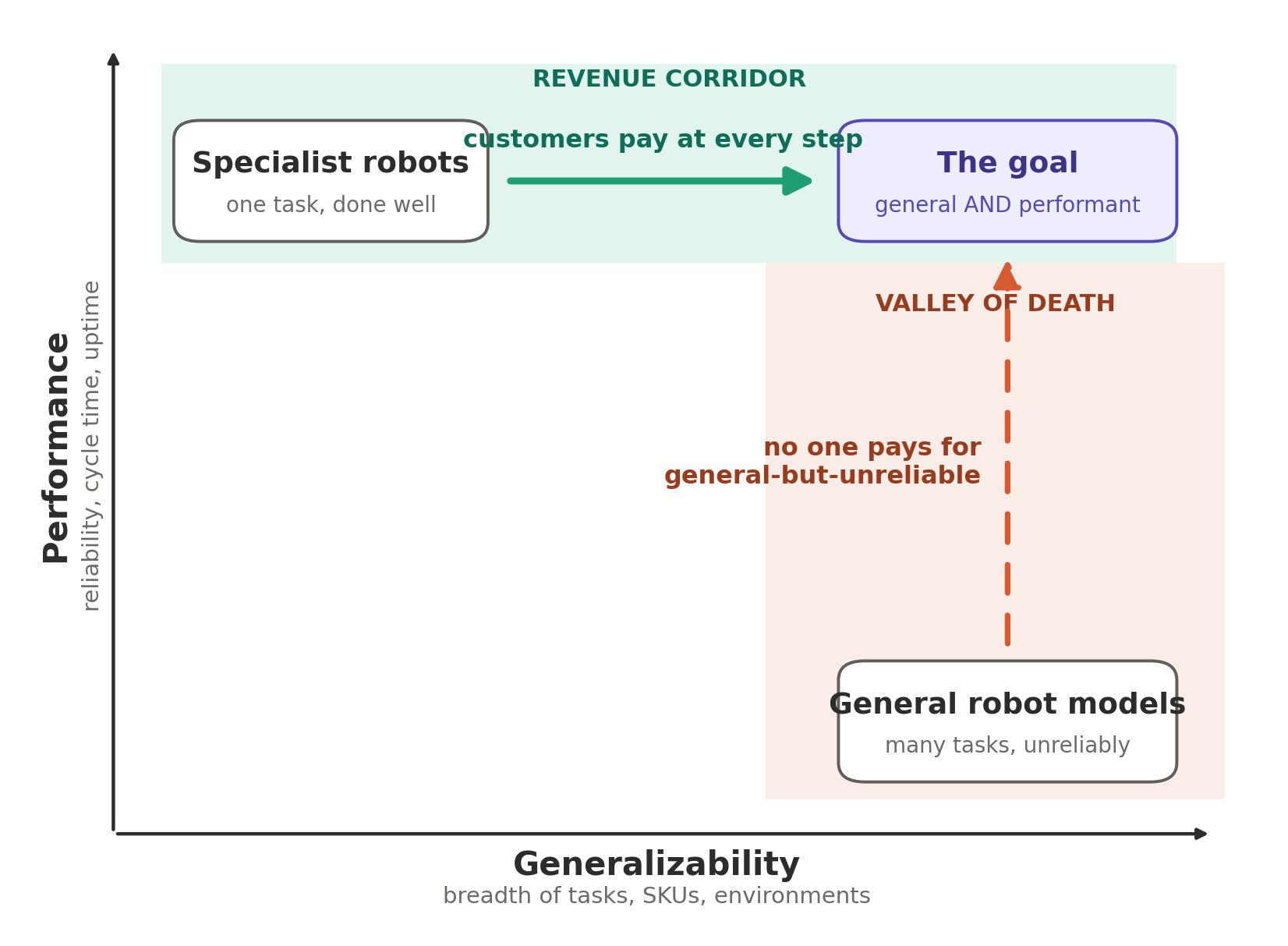
From an investor perspective, it’s the difference between backing a company like Amazon versus a drug discovery biotech. Both required billions in sustained investment across years. But Amazon funded its warehouse and datacenter buildouts by reinvesting profits back into the business. Biotech companies can raise billions across a decade and then simply die because the science failed. Both models can produce wins, but one has more control over its own destiny.
Revenue at the midpoints isn’t just important because of the runway it provides. Paying customers are compasses, helping you navigate as you build. They tell you what matters and what edge cases in the real world look like.
The Vertical Path or the Valley of Death
Some companies are choosing to start in the bottom-right and climb straight up. This is the generality-first bet being made by very smart people with very large checkbooks. In their view, generality is the hard part and performance is a scaling problem. If you train on massive datasets and deploy broadly, you can climb by letting iteration push reliability all the way up.
It worked for software and language models, so why not atoms? This is the thesis, in different forms, behind Optimus, Figure, 1X, Physical Intelligence, and Skild.
But factory economics are threshold-based, not linear. This means a robot with 85% task success isn’t worth 85% of one at 99.9%. In fact, it’s actually probably worth less than zero because each failure leads to wasted time, scrapped product, and/or additional headcount needed to oversee.
Saman remembers seeing just how costly a few hours of stalled production was to a customer in Formic’s early days. A stopped line at a mid-sized food manufacturer can cost $120,000/hour. So if a robot’s mistakes bring that line to a halt, getting it right only 85% of the time is pretty catastrophic.
The climb from general-but-unreliable to general-and-reliable happens off-revenue. In other words, if your general robot isn’t reliable enough for customers to pay for it, you have to fund that climb yourself. And without customer deployments, it’s very hard to know whether your internal benchmarks are accurate reflections of what will happen on a customer’s production line.
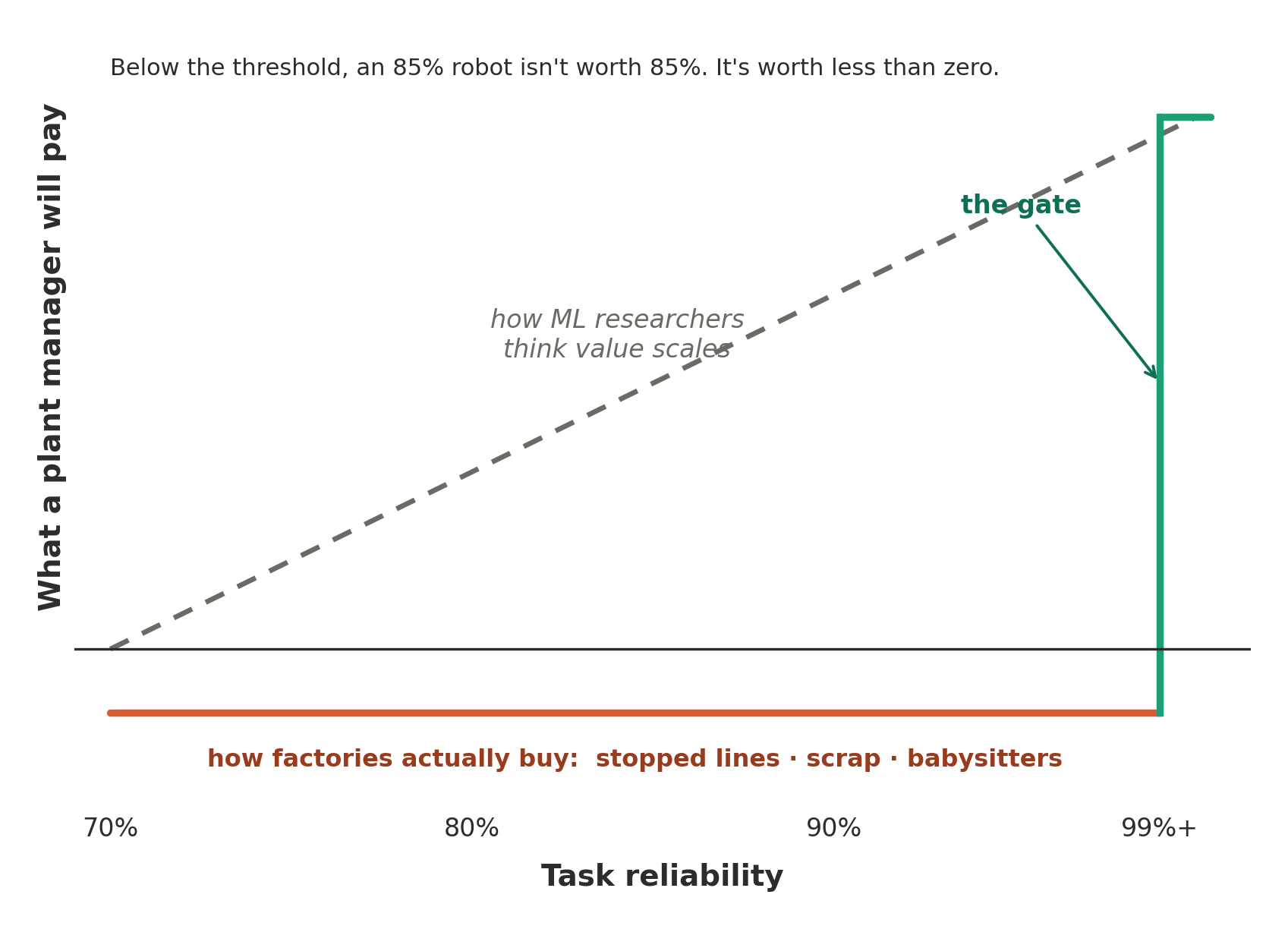
And while you’re climbing, the bar keeps rising. Specialists continue improving, and hard automation is only getting cheaper. The reliability threshold is set by your customer’s next-best option and that’s not a fixed altitude.
“But LLMs Did It Vertically”
Yes. GPT-3 was a general-but-unreliable system. It hallucinated constantly and yet a lot of people paid for it anyway. The generality-first crowd is pattern-matching to the most successful technology rollout of the century.
So why doesn’t it transfer? Three asymmetries.
Asymmetry #1: Cost of Error
A bad token is basically free. But a bad grasp is often a crushed part, a jammed line, more scrap, or worse. LLMs monetized their awkward adolescence because humans could fix the mistakes before their output went into the world. This isn’t the case for robots.
Asymmetry #2: Data
It would take a human more than 100,000 years to consume the text and images used to train today’s LLMs. There is no equivalent for manipulation data. The data that trains general robot models still has to be manufactured.
Asymmetry #3: Distribution
ChatGPT launched into a world where billions of people already owned the hardware needed to use it (think computers and phones). Robotics in 2026 doesn’t look like computing in 2023. It looks like computing in 1985. Today, there are ~5M industrial robots operating worldwide, but they were built to follow programmed routines, and getting them to work with newer AI control systems isn’t a simple software upgrade. The install base for these newer systems barely exists. Even if we handed you Physical AGI on a hard drive tomorrow, you couldn’t ship it, because the robots to run it on aren’t deployed.
Put the three together, and the LLM analogy doesn’t support the vertical path for robotics. In fact, it does the opposite. The winners of the LLM era were the ones who had the most data and the widest distribution. The winners of the robotics era will be the ones that start with narrow tasks that customers will pay for, then use the data from those deployments to expand. Over time, they will build toward a general robot while getting paid along the way.
The Horizontal Path: Revenue Is What You Need
Returning back to the performance vs generalizability chat, let’s look at companies that choose to start in the top left corner, and move right.
With this approach, you begin with a system that clears some reliability threshold in at least one task so you have something that can generate revenue from day one. Then you gradually widen, rung by rung on a ladder that looks like this:
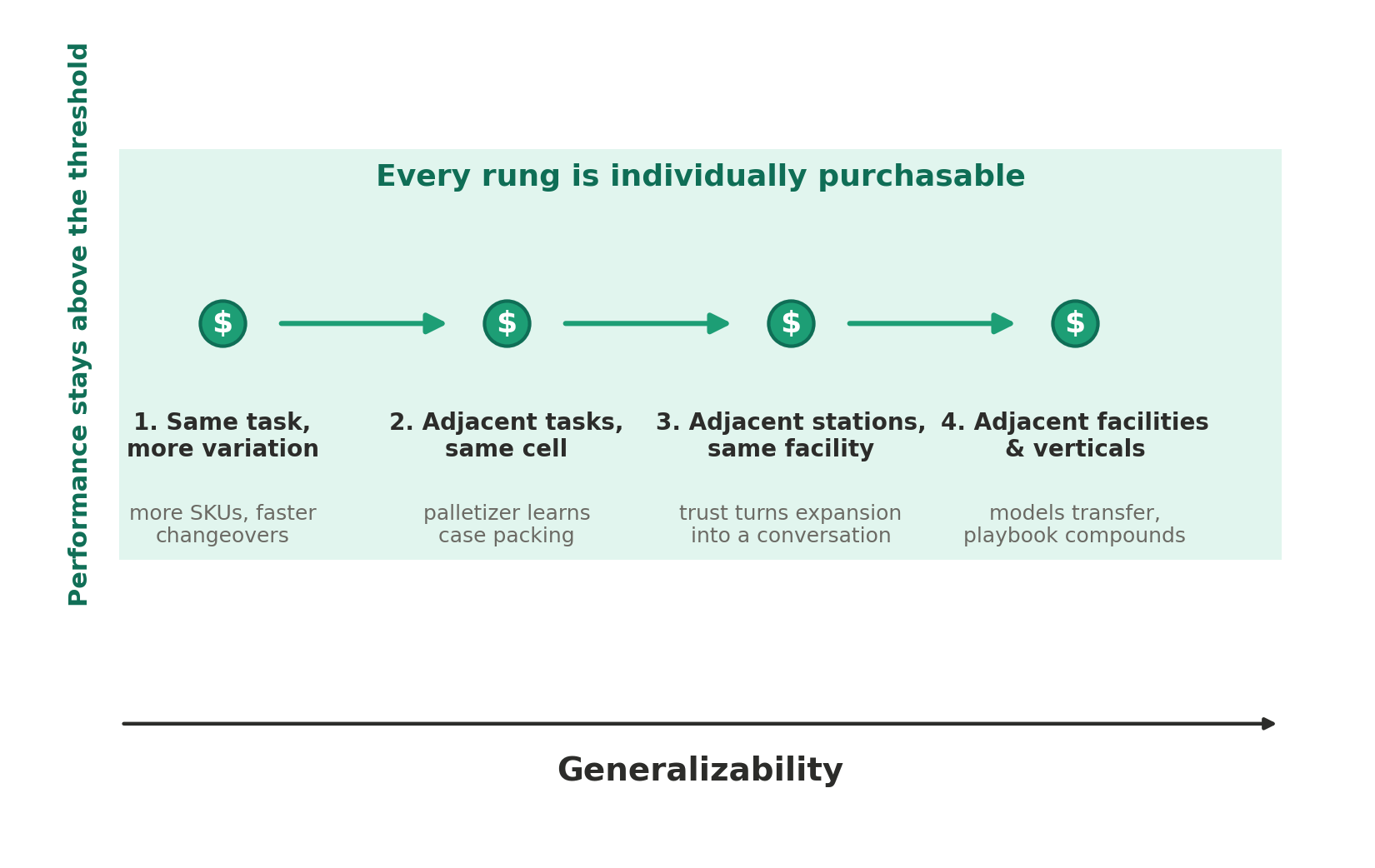
Rung 1 same task, more variation: the same robot handles more SKUs, package sizes, etc and can do it with faster changeovers. As an example, one Ohio snack manufacturer that Formic works with went from 300,000 pounds a week to over a million on the same footprint, starting with one palletizer and expanding once it proved itself.
Rung 2 adjacent tasks, same robot: the palletizer adds case packing; the welding bot adds setup and fixturing. It’s the same workspace, but it reduces the labor requirement. This is where generality starts kicking in.
Rung 3 adjacent stations, same facility: after a while, you earn the customer’s trust. New capabilities start to get adopted and expansion starts happening via conversations rather than formal sales cycles.
Rung 4 adjacent facilities and verticals: this is where the models transfer and the playbook starts to really compound. What you learn on one product line carries over to the next.
Importantly, every rung is individually purchasable.
This is the playbook of the companies that are actually winning customer contracts in physical AI right now. Path Robotics, for example, started at the top-left corner of our chart, a weld cell, but AI-native, so every weld across every customer trains a shared model that makes the next weld, and the next customer, better. Now they are expanding to other embodiments like quadrupeds and humanoids.
Saman and Formic are doing it in packaging and palletizing: 200+ robots across 120+ US facilities, running at 99.3% uptime, each one both a cash-flowing deployment and a data-collection site. For example, at a California dairy, one operator said the palletizing work had left her “unable to sit or stand after a shift.” A robot now does that job. Another example is at a plant making sauce packets and tableware where annual turnover was 130%. Robots helped the plant increase output by 25% and eliminate shipping errors. These examples are from different plants with different products, but each followed the same path. They started with one task, proved it worked, and expanded from there.
By starting narrow, you have customers that are ready to pay for work the robot can already do. And by doing that work, the robot is exposed to more variation and more things that can go wrong, giving you the data to improve it and take on the next task. This is how a business built around one seemingly narrow task can grow into something much more general.
Don’t Become a Systems Integrator
The horizontal path has a failure mode, and it’s called becoming a systems integrator.
There are thousands of automation integrators, capable, profitable, decades-old companies that have built specialist robot cells since the 1980s and have never generalized. Every deployment needs bespoke engineering, with nothing shared between projects. Each deployment is a snowflake with custom fixtures and custom code.
The escape from the integrator trap is an architectural commitment that is only possible today with AI: a shared model and software layer across the entire fleet, so every new deployment makes all deployments more capable. This is where AI changes the game in a way it never could for the integrators of the 1990s. Value built across customers and applications propagates back into one compounding asset. The integrators never had a substrate that could learn across projects, but now the substrate exists to build a company where every deployment makes the next deployment cheaper and faster.
The Fleet Is the Path
The top-right corner will be reached by whoever operates enough performant, data-producing deployments to fund and feed the generalization at the same time. It won’t happen from a single model breakthrough (the vertical bet) or by stacking a thousand bespoke point solutions (the integrator trap).
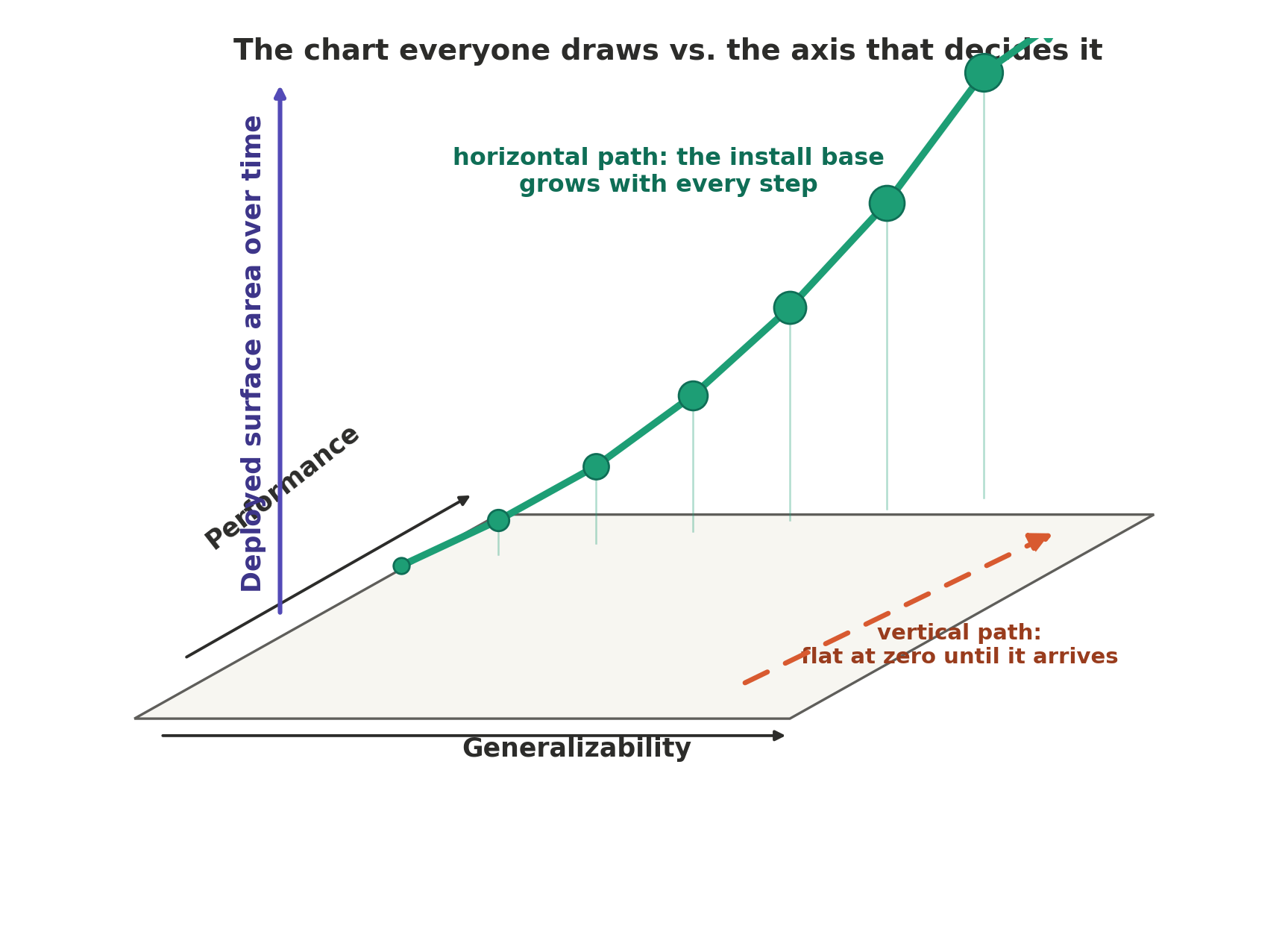
And while both the vertical and horizontal trajectories appear symmetrical on paper, they diverge on a third dimension: cumulative deployed surface area over time. The horizontal path continuously expands its active footprint across new customers and new capabilities. The vertical path, however, doesn’t have a viable commercial product until performance is finally good enough. This is an important difference in an industry where the install base provides both your revenue and your training data.
The horizontal path is the fast path for everyone.
America had 409,000 open manufacturing jobs in 2025, and as many as 1.9M could go unfilled by 2033. The vertical path asks factories (and investors) to wait for uncertain breakthroughs. The horizontal path deploys now: every working robot adds capacity, strengthens factories, and generates data for better models. That flywheel is why Saman helped start Robots for America. No company can close the gap alone; manufacturers, robotics companies, and policymakers have to move together. The greatest risk is that the flywheel spins too slowly.
That’s also why Haomiao and Annelies are excited to back companies that generalize within verticals: Path is expanding from welding into assembly and post-processing; Rhoda is tackling more factory manipulation tasks. Neither will fold your laundry anytime soon. Robotics abundance runs through this glorious “useful” path - what Travis Kalanick calls “gainfully employed robots”- getting more capable every quarter in unglamorous buildings, years before the glamorous version arrives.
The question was never what the end goal is. It’s whether anyone is paying you while you travel there.
Big thanks to Saman Farid and Haomiao Huang for sharing their knowledge. Saman is the founder and CEO of Formic, which deploys and operates robots-as-a-service across US manufacturing, and a co-founder of Robots for America. Haomiao is Founding Partner at Matter Venture Partners, an early-stage venture firm focused on HardTech, and was previously an investor at Kleiner Perkins, a roboticist and Co-founder & CTO of Kuna Systems.
Author’s note: An LLM was used for light copy editing only (spelling, grammar, and clarity). Content, meaning, tone, and structure remain unchanged.