

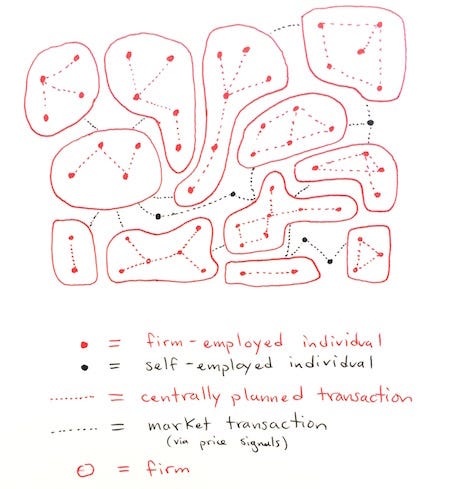
Much of the conversation around AI focuses on what agents will do to jobs as they automate a growing share of workflows. Just as important is what happens to markets once those workflows are handled by agents acting on behalf of both people and companies.
What changes when software becomes the buyer, recommender, negotiator, reviewer, scheduler, and gatekeeper?
I recently sat down with Andrey Fradkin, an economist who studies digital markets and the economics of AI. He is also the co-host of the Justified Posteriors Podcast. A lot of his work is focused on not only how AI changes productivity inside firms, but also how it changes the structure of markets themselves.
Our conversation explored what happens when agents lower the cost of search, bargaining, matching, and representation – and how that could reshape firm boundaries, market design, and where value accrues.
AI as a transaction-cost shock
In “The Nature of the Firm,” Ronald Coase argued that firms exist in part because they reduce transaction costs: the frictions involved in searching for information, negotiating agreements, and enforcing them. As Andrey put it, “firms are islands of dictatorship in the middle of a market economy.”
Coordinating through markets is costly. Search is costly. Contracting is costly. Negotiation is costly. Monitoring is costly. Representation is costly.
“We have firms in the first place because there are transaction costs,” Andrey said.
But AI is beginning to rewrite those transaction costs.
Agents automate tasks. And in doing so, agents lower the cost of coordination between people, firms, and systems. When that happens, the boundary between what gets done inside a firm and what gets done through the market can start to shift.
“We might see firms – I don’t want to say dissolving – but how they’re organized might be very different,” Andrey said. In other words, if agents really reduce the cost of search, matching, bargaining, and representation, they make new market structures possible.
Representation may get cheaper too
One implication of this is that forms of representation that used to be too expensive may move downmarket.
Historically, many people only got access to agents or intermediaries in very high-value transactions. A Hollywood agent. A sports agent. A high-end recruiter. A broker. A trusted negotiator. Someone who knew the market better than you did and could represent you inside it.
“What is the purpose of those people,” Andrey said, “is that they’re experts in doing a particular transaction, and they have a lot of information.”
The reason we do not all have those services for every market interaction is because they are expensive.
“They’re only worthwhile for big enough things,” he said.
But if the cost of that representation falls dramatically, the economics change.
“Now maybe everyone can have a professional AI labor agent,” Andrey said. “They would scout for all the job openings, prep you for your first round interview, represent you to the employer agent in the correct way, and help you negotiate a salary.”
You can extend that idea well beyond labor markets. Procurement. Insurance. Logistics. Vendor discovery. Expert matching. Commercial negotiations. Many industries still depend on human intermediaries because the work of navigating the market is still fragmented, contextual, and full of small frictions.
Agents may compress a lot of that.
Lower friction creates efficiency, but also breaks signals
Lower transaction costs mean less friction. But many markets also depended on that friction.
As Andrey put it, “a lot of society has worked so well because of transaction costs.”
Costly effort used to be a signal. A thoughtful outreach email. A carefully tailored application. A detailed explanation. Even if these things were imperfect, they often served as evidence of intent.
“If I wrote you a very thoughtful email about why it would be worthwhile having a conversation,” Andrey said, “then you might say, well, this person really has a good reason to meet with me. But that signal has now gotten destroyed.”
AI can now generate the appearance of effort at essentially zero marginal cost.
The old filters thus stop working. Outreach gets cheaper, but congestion rises. Representation gets easier, but trust falls. Coordination gets faster, but attention gets harder to allocate.
I think this is why so much discourse online collapses into “I don’t want to read your AI slop.” People are reacting to the breakdown of effort as a signal.
In a world where polished output is abundant, what becomes scarce is credible intent.
The next layer of value may sit in trust infrastructure
So if effort is cheap, markets need new ways to establish credibility.
If agents act on behalf of users, they need to know preferences, know when they are uncertain, and know when to ask for more information.
If AI systems interact with each other, they need stronger identity, verification, and reputation systems.
“The agent doesn’t know your preferences. And a lot of agent failures are because of this,” Andrey said. They are failures of representation. The system does not know what you value, where the threshold is, what tradeoff you would make, or when it should escalate uncertainty back to you.
He also pointed to a deeper technical issue: currently agents are really bad at knowing what they truly know or don’t know.
“You can ask an agent in a lot of cases, ‘How confident are you in this answer?’ and they’ll give you a number that’s really poorly calibrated.”
This is what makes the trust and governance stack around agents so important. This could mean identity and proof-of-humanity infrastructure. It could mean AI-native reputation systems. It could mean software that helps agents learn and represent user preferences more faithfully. It could mean calibration layers, confidence estimation, escalation logic, compliance rails, or vertical systems that become the default authority on what “good” looks like.
Some old market mechanisms may come back
Ironically, AI agents may in fact make certain outdated market designs viable once again.
For example, “we may want to use auctions a lot more,” Andrey told me. While auctions can often allocate supply and demand more efficiently, many markets still rely on simpler mechanisms because they are less cognitively demanding for humans. “The reason we don’t use auctions today is that for normal consumers, it’s a pain to participate in auctions. You have to monitor them.”
But agents don’t care about that. They can monitor and wait as long as needed. They can participate in hundreds or thousands of processes at once. They have, in effect, infinite patience.
And if agents absorb that complexity, some markets may move back toward more efficient pricing mechanisms: auctions, dynamic pricing, more granular negotiation, and continuous matching.
I suspect that will matter most in fragmented B2B markets: procurement, freight, insurance, industrial sourcing, bespoke quoting, and anywhere else that still runs on manual back-and-forth.
Redesigning markets, not just workflows
As agents proliferate across enterprise and consumer workflows, there will be many opportunities to redesign the institutions and market mechanisms that intelligence plugs into.
“AI is a technology that’s drastically reshaping transaction costs,” Andrey said toward the end of our conversation, “and that may end up reshaping markets too.”
Lowering transaction costs doesn’t automatically make firms simpler or markets cleaner. In many cases, it may actually create new forms of congestion and fragmentation. But it also opens the door to new ways of matching supply and demand, allocating attention, establishing trust, and coordinating work. If software becomes the buyer, negotiator, scheduler, recommender, and gatekeeper, then market design becomes a product surface.
Andrey Fradkin is on-leave working on economics of AI topics at Amazon, but these quotes represent his views and not those of Amazon.
Author’s note: An LLM was used for light copy editing only (spelling, grammar, and clarity). Content, meaning, tone, and structure remain unchanged.
The trust infrastructure point is the one that keeps me up at night (honestly). When effort-based signaling breaks - when anyone can generate polished content, polished bids, polished credentials - reputation systems need to do a lot more work.
The transaction cost framing is useful though. I hadn't thought of it that way: agents reduce search cost but they also reduce friction, and friction was doing invisible trust work. A human had to show up, answer questions, prove availability. An agent just... responds instantly, always, forever. What does credibility even look like when the cost of appearing credible goes to zero?
AI *increases* transaction costs.
Agents are distinct by their capture of scarce resources—context or actions.
Any agent distinct by context is an information monopolist, who maximizes profits by vertical integration, not eroding their scarcity by telling everyone their alpha.
The coasean effect is actually the opposite. Firms with high value context *become very large*.
I mean, it’s trivially true that traditional transaction costs fall.
But negative externalities from transacting are clearly also transaction costs.
I think a helpful way to imagine it is that every agent or company is an instance of Claude with identical capabilities. If they’re profit-maximizing, why would they transact if transacting is informative and weakens an advantage?
Illustrative: notice more than half of all public market trade volume happens off-market / in dark pools.