

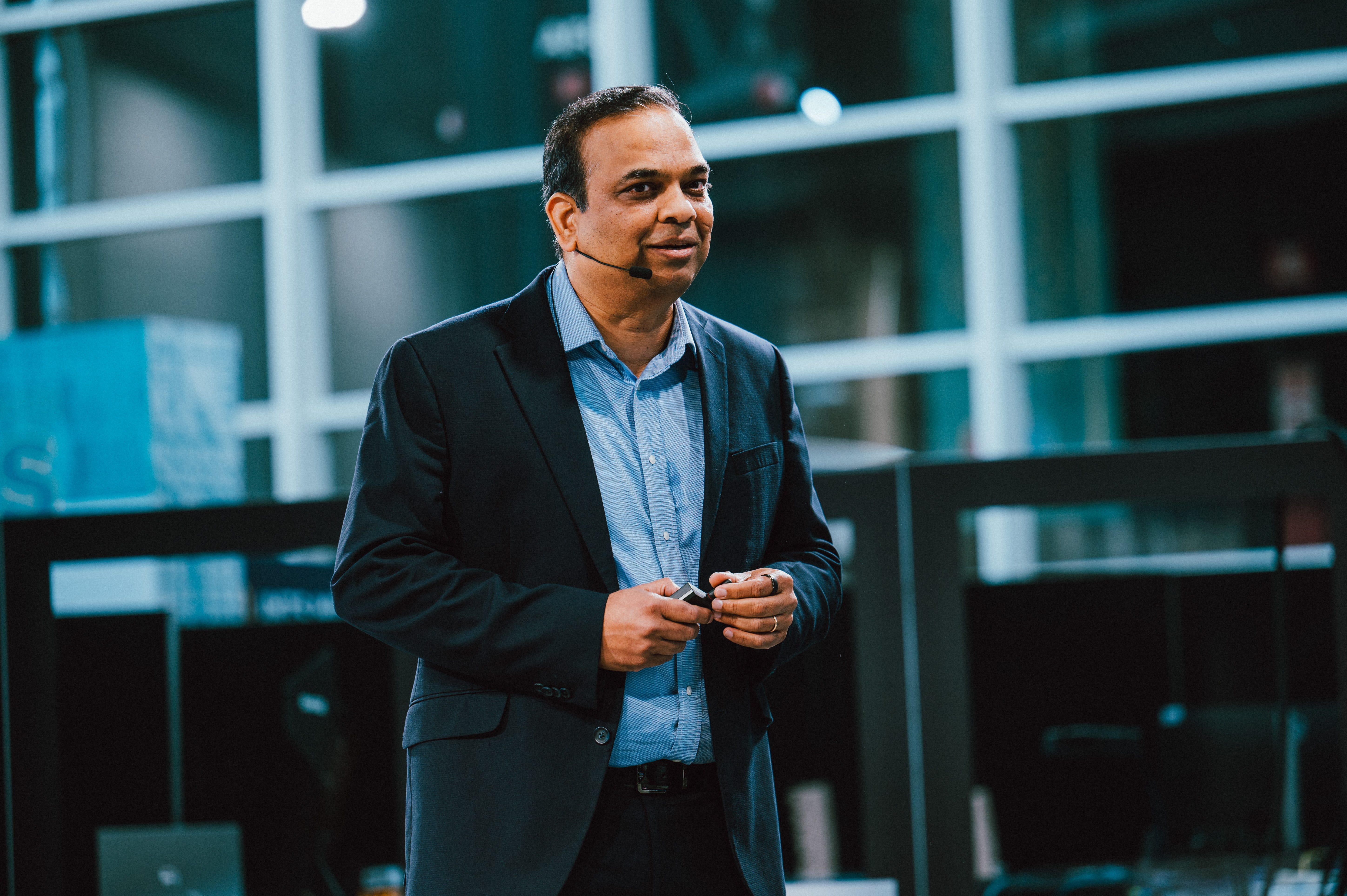
“It’s always harder to solve a Jenga problem than solve a chess problem.” Praveen Rao told me the other week when we were talking about AI in manufacturing.
Unlike many other industries, in manufacturing, you’re working with a physical environment and legacy existing equipment, and many interdependent processes. Everything is tightly interconnected and thus every action has consequences for the rest of the system.
Praveen leads manufacturing at Google Cloud and is a mechanical engineer by training. Over his multi-decade career in manufacturing, he’s worn the CIO and CTO hats and been at companies including IBM, and AWS.
In our conversation, we talked about what it takes to move industrial AI into production, how autonomy changes jobs and the economics of manufacturing, and where founders can build beyond the hyperscalers.
“Your pilots are like the seeds, but data is the soil that you have to till”
“In manufacturing, we don’t have the luxury of scrapping everything and starting over,” he told me when talking about the constraints shaping the industry right now, everything from the data architecture to the buying decision. A plant manager is measured on production, delivery, and safety so what they care about is, as he put it, “delivering what they’re supposed to deliver, and doing it safely.”
Praveen calls the scaffolding around many early pilots “duct tape architecture.” It can demonstrate feasibility while leaving the harder deployment questions unanswered.
“Can you do it with 10,000 people collaborating with each other,” he asked, “while accounting for change management and the response times the operation needs?”
“Your pilots are like the seeds, but data is the soil that you have to till and stakeholder sponsorship is what sustains the effort,” he said. In other words, you have to build the conditions in which the pilot can become an operating system people actually use.
“Always keep the outcome in mind, what you are trying to achieve.”
Semantic data is the assembly line for profitability
“These machines were built thirty years ago. They absolutely didn’t have any semantics or context,” Praveen said. “You go get the data from a machine, and you just get a sensor value of 25. Somebody has to interpret what that really means. And you have to do this 100,000 times, across multiple factories, with so many different sensors.”
There are two connected challenges around understanding data from machines and then being able to reason over that data. The first is integrating equipment that uses different communication standards, such as Modbus, MQTT, and OPC UA.
And the second is then giving its data enough context to be useful. This means understanding what a reading measures, which machine it belongs to, and how it relates to the production process. This includes connecting to the rest of the production process (the order, the bill of materials, the supplier, the production line, the operator, and the history of how a product was made). This is the semantic layer and, coupled with raw sensor data, is what enables an AI agent to operate effectively.
“Semantic data is really the assembly line for profitability.”
So across the various handoffs between an engineering system and production planning, the meaning and the relationships have to survive each handoff.
Praveen pointed to Gemini’s benchmark strength at navigating graphs, then connected it to the shop floor. “Assemblies of products are nothing but graphs,” he said. “You have a big assembly, subassemblies, and parts.” Once a model can navigate that graph, applications can be built on top. Examples of those applications are change-order management, identifying duplicate parts, surfacing similar past projects to build better proposals, etc.
I asked whether the age of installed equipment means manufacturers will eventually have to start over. Praveen doesn’t think so and actually argued it wouldn’t be economical anyway. Instead, he sees the path being more around retrofitting sensors to capture signals like vibration, temperature, or pressure in situations where the equipment itself doesn’t provide this granularity. In other words, he believes the architecture has to accommodate what is already there.
AI permissions in a factory
As discussed with Shiv Trisal from Databricks the other week, manufacturing has been plagued by a surplus of insights and alerts, but is still behind on connecting those to actions and interventions.
Praveen described a progression “from systems of engagement, systems of record, to systems of intelligence, to systems of action.”
“The diagnosis needs to lead to treatment, another measurement, and confirmation that the patient improved,” he said. In a factory, that means connecting observation with execution with feedback.
“You need to work in a deterministic environment and in a closed loop environment when you’re coming to manufacturing,” he said.
The system needs clear boundaries around the actions a model can propose and the conditions under which those actions can execute. Permissions, process constraints, and operator authority all become part of the product.
“It’s a contract between the AI tool and the systems of record that’s providing this input. That way, AI accesses only what is needed. It executes the contract versus overwhelming a system,” Praveen told me. He gave the example of thousands of agents requesting information from an ERP system. Even an otherwise useful agent can create problems through excessive requests or access beyond the needs of its task.
Human authority has to be explicit, too. “You empower your people to have the kill switch,” he said. “That’s how you hold people accountable as well.”
Praveen sees the worker’s role expanding from “a doer” to “an orchestrator”. “So in essence, they got a promotion,” he said. The new workload includes orchestrating events around diagnosing equipment, configuring machines, coordinating workflows, and initiating maintenance.
I’m excited about this shift because it changes the economics of manufacturing. When a worker orchestrates ten workflows instead of executing one, output stops scaling linearly with labor. Productivity per person and the margin structure of the factory begins to look less like traditional manufacturing.
The economics of autonomy
There are projected to be 3.8M open manufacturing jobs by 2033. And today, it takes two to five years to onboard a manufacturing employee. “We can’t just hire our way out,” Praveen said.
Physical AI and robotics are part of the answer to that gap. When I asked whether the hype around humanoids was justified, Praveen was optimistic about their potential. “The world is built for humans by humans,” he said, so there’s a good reason to build machines that can function in environments designed for us.
But even 99% accuracy is too low in the manufacturing world. Six Sigma, the industry’s standard quality bar, allows 3.4 defects per million. Most robotic benchmarks aren’t even close to that. Even on controlled simulation benchmarks, top models land in the 70-90% range.
Praveen’s advice for deploying robotics mirrors his advice for deploying AI generally: “Start from an outcome. What is the thing you are trying to do? Work backwards to what kind of body you need to be able to do that.” The form factor is a byproduct of whatever problem you’re trying to solve. Put another way, he said “Don’t obsess over the body versus the brain.”
Another factor in all of this is how humans will work alongside robots in the future. Praveen believes there will always be an important role for humans in manufacturing and so he thinks we need to do more research into how humans stay motivated and relevant when surrounded by machines that can perform parts of their job better than they can. People need a clear understanding of their own responsibilities and growth trajectories. Their cooperation and involvement will shape robotics adoption just as much as the technical capability of the systems.
After all, “people support what they help create,” Praveen said.
The opportunities

Toward the end of our conversation, I asked Praveen what he would build if he were starting a company today.
He first answered by saying what he wouldn’t build, which is anything around an apparent gap in a cloud offering. “You never know what they have in the product road map. They may be planning on it, like, two months from now.”
Instead, he pointed toward operational technology and the application of AI within industrial processes. “Think about what we are doing in IT and replicate it on the OT side. It’s almost a greenfield. You have the whole world for yourself.” Describing Google’s position, he said, “We don’t see us building manufacturing machines. That’s not really our forte.”
For the models themselves, his advice is to build on top rather than compete underneath: “Take these large language models, which are like the runways, and build your airplane that can take off from them.”
It’s hard not to share his enthusiasm. “We’re living in the most exciting times in human history,” he told me. Problems that stood unsolved for a hundred years are falling. “If we can do it now, imagine what we can do two, three years from now.”
Check out this video to learn more about how Google Cloud is using AI and data to transform the operations of global manufacturers.
Author’s note: An LLM was used for light copy editing only (spelling, grammar, and clarity). Content, meaning, tone, and structure remain unchanged.