

American manufacturing is getting a lot of attention right now, but most of the conversation is happening at the tip of the pyramid: chips, EVs, aerospace. You don’t get any of those without the unglamorous base: the tooling, subassemblies, fasteners, castings, turbine blades, the thousands of parts and processes that make the end products possible.
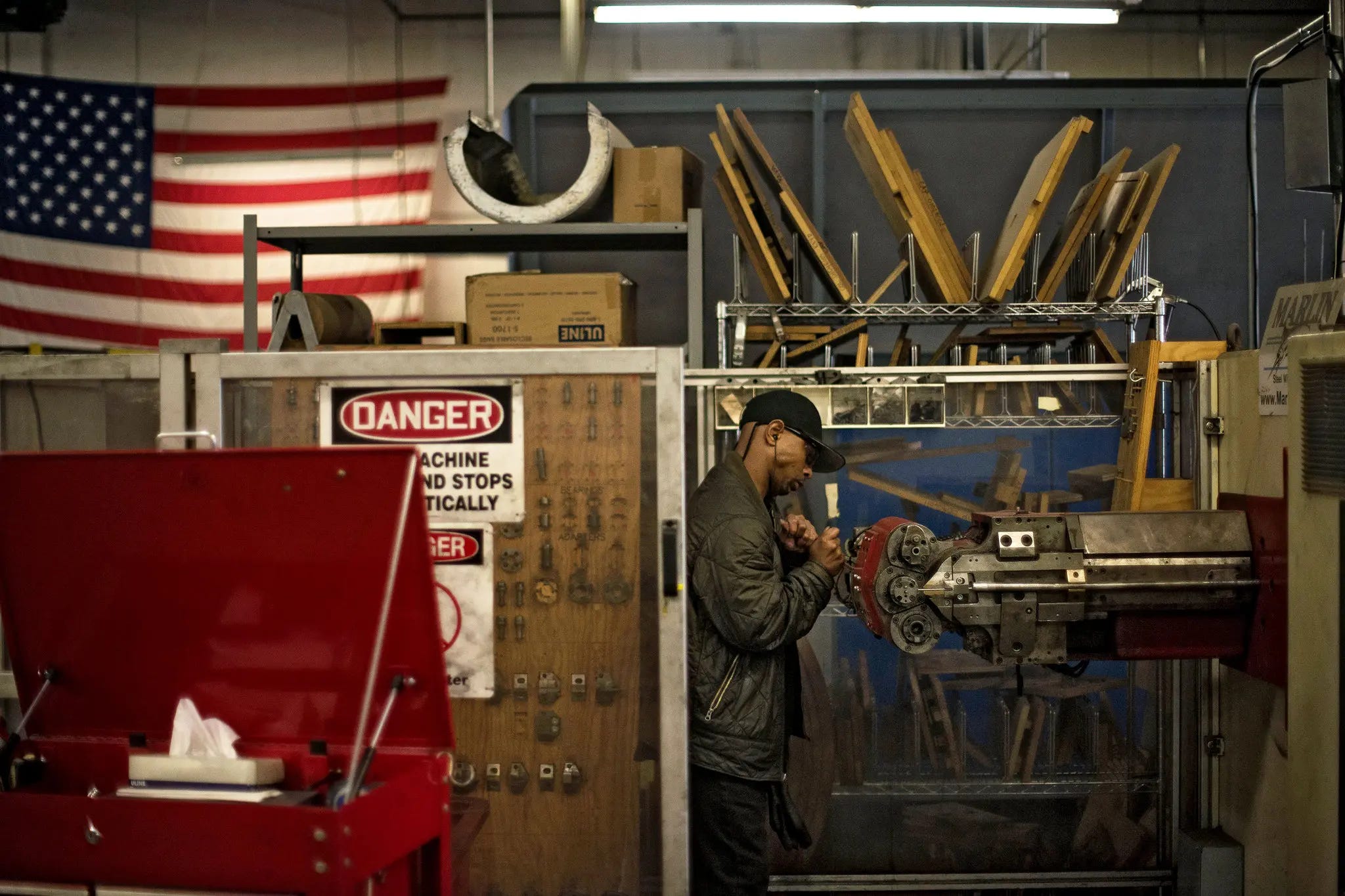
Look at a single automotive plant and you’ll find roughly 4,000 suppliers feeding that one facility. In aerospace, it can be closer to 20,000. Even in simpler categories, the ratio might be 5:1 or 10:1. That long tail is where most manufacturing actually happens, and it’s where innovation has lagged the most.
“The US is trying to rebuild manufacturing by over-investing in the tip of the pyramid, without rebuilding the middle that makes the tip possible,” Saman Farid, the founder and CEO of Formic, told me. “We’re reasoning backward from chips and EVs as if the supply chain between here and there is already solved. It isn’t.”
China’s Supply Chain Density
China’s manufacturing ecosystem was built over decades from the bottom up. Raw materials. Then steel. Then simple assemblies (toys are a classic example). Then gradually more complex work up the chain, until the supply base became both broad and dense.
If you’ve ever worked with Chinese manufacturers, you feel that density immediately. At my last company, we both competed with and partnered with Chinese suppliers. When we competed, we were often an order of magnitude more expensive, and lead times were longer in ways that surprised people. Even quoting moved at a different speed: Chinese manufacturers could turn around complex quotes within 24 hours. In many other markets, including the US, that same process can take weeks.
I saw the same dynamic when I flew to a customer’s headquarters to present to a room full of their Chinese suppliers on what it would take to set up factories in Mexico to navigate tariffs and take advantage of USMCA and IMMEX. When I shared timelines for building a factory from the ground up, there were audible gasps. Some thought I was joking. In China, many of these teams are used to going from breaking ground to first production run in months.
Saman told a similar story from his time building plants in China. His team walked a facility at 6pm, flagged several changes, including adding a staircase, went back to the hotel, and returned at 8am to find it done. Including the staircase.
China’s supply chain density means compressed distance and coordination costs. Parts, labor, contractors, and owners are all nearby. The whole system moves together.
Subsidies As An Investment
A common explanation for China’s manufacturing dominance is that the government “propped it up” with subsidies. Saman sees it differently. “Subsidies are an investment,” he told me. “It comes down to how many dollars you put in for how many dollars you get out.” China subsidizes selectively to build specific capabilities and capture downstream value.
In practice, this looks less like handing out jobs and more like engineering demand and lowering the cost of capacity through procurement, cheap credit, subsidized land and power, and coordinated supplier buildouts designed to keep factories utilized. When an industrial park comes online with subsidized land and power – and local financing makes equipment easier to purchase – it becomes faster to spin up production, and easier to scale it. High utilization then compounds: factories run more hours, quote faster, learn faster, and reinvest faster.
And China isn’t uniquely subsidy-heavy. “People ascribe too much importance to subsidies in China,” Saman said. “The reality is most factories in the US are also subsidized.” The difference is that American subsidies often show up indirectly through tax abatements, accelerated depreciation, low-interest loans, programs like SBIR and the SBA. Both countries use subsidies, but China paired them with a long-term, bottom-up effort to build capability at every layer of the supply chain. As Saman put it: “Supply chain density, labor density, skilled labor, and breadth of suppliers matter. Those take many years to build.”
In the US, all of this has thinned out. Some categories offshored. Others consolidated. Supplier bases fractured across geographies. Now we’re trying to rebuild, but we’re still over-allocating attention to the top of the pyramid without rebuilding the connective tissue that makes the top possible.
The Utilization Problem
Manufacturing competitiveness is a messy bundle of variables – wages, training, materials, regulation, energy, logistics, the cost of capital. But a lot of it ultimately comes down to utilization. In the US, plants don’t run nearly as many hours as they could.
“A typical US factory might run around 2,000 hours per year out of roughly 8,600 possible production hours, whereas factories in China often run 6,000 - 7,000 hours annually,” Saman said. “With the exact same building and the same category of equipment, one factory has triple the output. So of course it’s going to be cheaper.”
So when we talk about strengthening US manufacturing, is the answer really to build another 400,000 factories? Or to help the existing base run 2x more? “The latter is obviously much easier,” Saman said.
Reliable Labor at Scale
Increasing utilization, in many cases, means increasing labor. One of Formic’s customers is a family-owned business that packages walnuts for major retailers. It’s a ~$150M/year operation in a small town where the factory employs something like 60% of the local population. They’d happily take on more orders, but they can’t – not because demand isn’t there, but because the local labor pool is fully tapped out.
One way to address the labor problem is to make robots easier to access and deploy.
But robotics doesn’t scale like software. “People are hoping there’s going to be a ChatGPT moment for robotics, but that’s a mistake,” Saman told me. “The hard part is the operational complexity. How do you evaluate the factory? How do you install the robot? How do you manage and maintain it? How do you keep it running 24 hours a day?”
Most factories don’t want to become experts in integration, maintenance schedules, spare parts, uptime monitoring, and safety audits. They want output. So Formic is focused on making robotics feel less like one-off integration projects and more like dependable industrial equipment. This means systems that run continuously without babysitting, handle variance in inputs, withstand different factory conditions, can be repaired quickly when something breaks (because everything breaks), and operate safely around humans at realistic payloads and speeds, or what Formic refers to as “Full Service Automation.”
“There are a lot of people who are trying to make robots smarter,” Saman said. “And I think that’s a good thing. It’s necessary, but it’s not sufficient.” What matters is making robots intelligent enough that you can plug them into any part of the production line and they just start working.
A Narrow Focus for 99.99% Uptime
“Most successes in robotics require 99.99% uptime,” Saman told me. “Most people underestimate how hard that bar is to hit.” He pointed to self-driving as an analog: it took two years to get to 80% performance, then another 15 years to approach 99%. And it’s still constrained by context. For example, Waymo only works in a couple of cities. You can’t drop it in Zimbabwe and expect it to work.
So what parts of robotics can we realistically push toward 99% and deploy in the next few years? Not general-purpose everything, Saman argues. More often, it’s narrow tasks with clear performance requirements and strong ROI, the kinds of jobs where you can standardize the environment and measure success.
That’s why Formic has focused on a relatively narrow set of use cases that repeat across many factories. Packaging is a good example: every CPG company has to package product. It’s a broad category of work, but still bounded enough to design around. The robots Formic builds can’t do everything, “you can’t take that same robot that’s doing case packing and expect it to fold your laundry,” Saman said. But most factories aren’t asking for a robot that can do a thousand unrelated tasks. They’re asking for one task done extremely reliably, day after day.
Form Factor Tradeoffs
Optimizing for reliability also shapes how Saman thinks about form factors. He argued against humanoids as the default factory robot, largely on straightforward engineering tradeoffs: a humanoid has far more actuators than an industrial arm, which means more failure modes, more downtime, and more maintenance.
He sees a place for humanoids in the future, especially for low-utilization, flexible work that hops between short tasks. But he doesn’t think they’ll dominate industrial deployments. “Why insist on two arms when a specialized machine could have six? Why insist on legs when wheels are faster and simpler?” he said. “A human on a bicycle is the fastest animal in the world. And a human on legs is one of the slowest. If we’re not able to leverage some of our creativity to find better ways to do things, it will be a big missed opportunity.”
The “Dirty Work” Opportunities
When I asked Saman what opportunities he’s most excited about, he cautioned that “there are a lot of opportunities to grift right now. It’s very seductive to believe we’re right around the corner from robots being everywhere, and it can be hard to draw a clear dividing line.”
At the same time, he sees massive opportunity in what he called “the dirty work around robotics” – aka, the infrastructure needed to ensure dependable uptime. Some examples we discussed:
Maintenance at scale: Someone needs to build a modern, nationwide robot maintenance network – the equivalent of what exists for heavy equipment or fleets. This includes managing lubrication, gearbox swaps, motor replacements, cleaning sensors, managing spare parts logistics, and more.
Data collection that transfers: There are creative approaches emerging (such as collecting motion data with gloves), but generalization is still hard. Collecting enough real-world data across environments and hardware types is a much bigger problem than people expect.
Financial tooling that makes adoption easy: A lot of small and midsize manufacturers don’t want to buy a complex system that they may not be able to maintain. They want a clear monthly cost and a reliable outcome. Financing models and bundling are important parts of the overall infrastructure needed to usher in adoption.
Compliance for robots: Safety and compliance are still deeply under-appreciated. In factories, robots have to operate inside rules designed to prevent injury when (not if) something goes wrong. Speed and payload determine risk, and risk determines how close humans are allowed to be. As Saman put it: “If you’re operating at X speed with Y payload, what’s the closest that a human is allowed to be near that robot before you have to shut it off?” That distance is calculated based on stopping time, motion profile, payload, and worst-case failure modes. And while safety rules likely need to be modernized, the reality is that a surprising number of robotics companies are effectively ignoring these constraints today, though that will likely change as robots become more prevalent.
These are just a few of the ideas we discussed, but they point to what Saman is most excited about, which is the unglamorous work required to deploy robots effectively at scale.
The Substrate For Abundance
US manufacturing dominance is about rebuilding the connective tissue underneath our supply chains. Higher utilization of the factories we already have, automation accessible to the long tail of plants that don’t have in-house robotics teams, maintenance networks and deployments that work across messy environments. Getting more hours out of what’s already there.
For what it’s worth, I don’t think everything should or even can come back to the US from a pure resilience standpoint. Global supply chains exist for a reason, and “China+1” may remain the right answer for many categories. But from an economic standpoint, manufacturing is the substrate for abundance: it determines how quickly a country can turn ideas into physical reality, how much it can produce per worker hour, and how resilient its industrial base is when conditions change. As Saman put it, “manufacturing is the foundation for human civilization.”
Author’s note: An LLM was used for light copy editing only (spelling, grammar, and clarity). Content, meaning, tone, and structure remain unchanged.
as someone with years of experience in manufacturing, i agree that labor is one of the main pain points, i'd say that there's still a lot of questions as to how much robotics will help to solve this ( especially in the coming years). i think it will be a while before we see robotics that can replace (or supplement) human labor, definitely excited to see what develops over the years.
Love this - Saman and the team at Formic are amazing. 🤖