

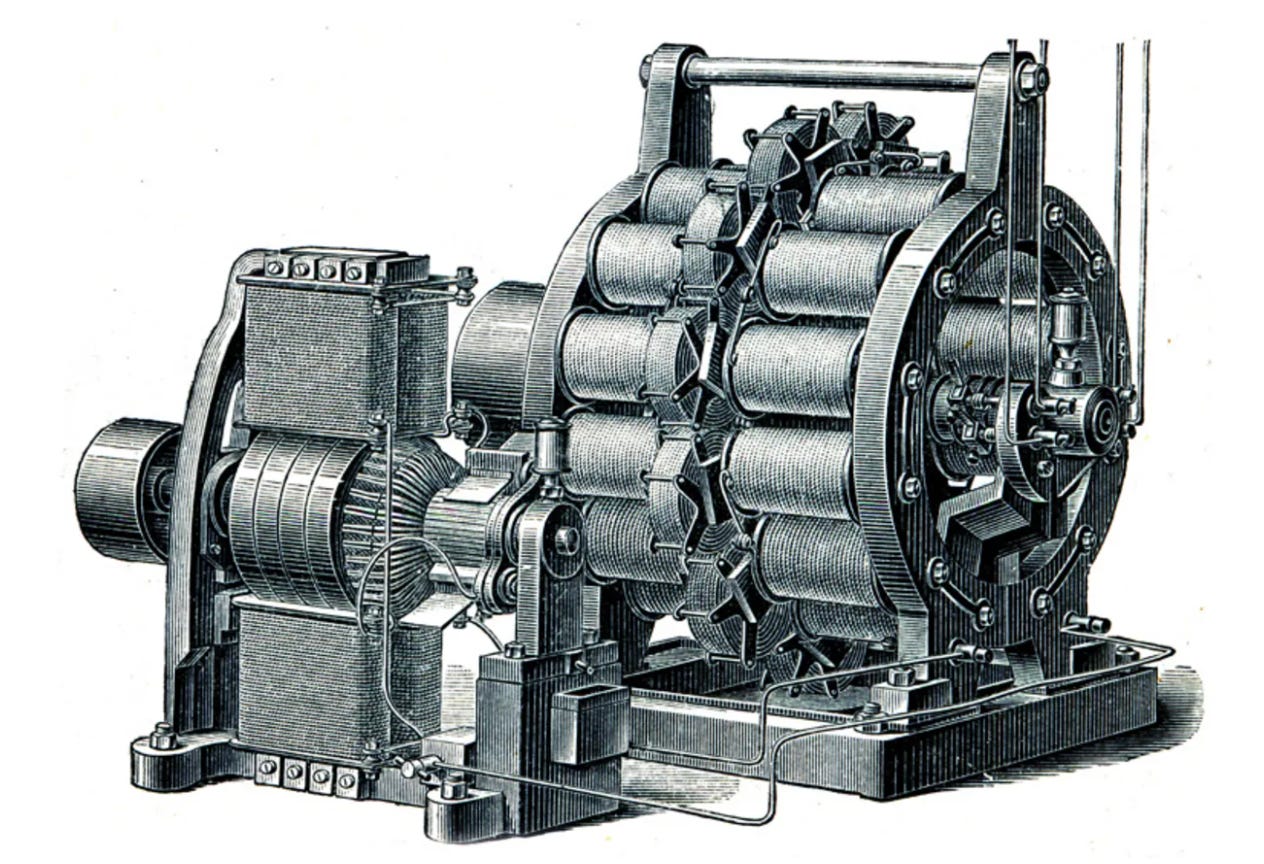
In Pablo Lubroth’s interview of Jack Scannell, Scannell references an analogy made by David Shaywitz where he draws a parallel to the early electrification of factories during the Second Industrial Revolution. In the decades after electric power arrived, many factories simply bolted an electric motor onto a layout built for steam, and saw almost no gain. The returns came only once the whole floor was redesigned around the new power source. That rebuild took decades.
It feels like we’re at a similar point in the AI revolution. We’ve invented the AI equivalent of the electric motor, but we’re still bolting that capability onto layouts built for steam.
This is especially true in many physical domains where AI is getting very good at the technical steps around generating designs and simulating how they’ll behave. But translating that capability into an output in the physical world is still a work in progress.
Where this shows up in manufacturing
In manufacturing, AI has moved fastest on the upstream, design-adjacent work. It reads 3D CAD geometries and technical drawings and turns them into production parameters, cost estimates, and toolpaths. It flags manufacturability problems (thin walls, features a tool can’t reach, tolerances a process can’t hold) and suggests fixes.
These tools are about design. But what matters most is reliably producing high-quality goods at scale. And this is bounded by physical cycle times, which accelerating design work doesn’t really impact. You can model a part in seconds, but you still have to cut the tool, run the line, measure what comes off it, adjust, and run it again. Speeding up design doesn’t compress the loop that actually takes the time.
This part of the loop, the physical production, also generates valuable data around what actually came off the line, and if/where it deviated from spec. Feeding that back into the AI design and simulation tools is what closes the loop, producing better designs on the next run. So, in theory, while you can’t make any single physical cycle faster (yet), you can make each run teach the next one, thus reducing the number of runs needed to reach the yield or quality you’re after.
This is why the promise of the AI-native manufacturer is exciting. It points toward systems that try to orchestrate the whole line, from design through to finished output. The premise is that once you own the entire loop you can close it. As the upstream design tools proliferate, this is where I think the value will accrue. Rather than bolting an “electric motor” into a legacy factory, these new entrants are electing to rebuild the entire factory.
Where this shows up in life sciences
The same dynamic is also playing out in life sciences. Two excellent recent pieces acknowledge that although we’ve made designing molecules easier and cheaper than ever, the hard part (and likely where value will accrue) is now validating those designs in humans.
Carlos Outeiral, in The antibody revolution is real. The business, less so. explores how, once several labs plus open-source models can all design comparable antibodies, the design step commoditizes, margins compress, and what ultimately ends up mattering is the asset itself, a differentiated drug. As he puts it, “the real problem is whether the antibody produces a real benefit in a real patient, which is a property not of the molecule but of the biology, and which no amount of binding affinity or easily assayable properties can buy you.”
In the Decoding Bio interview I mentioned at the start of this piece, Scannell argues that one of the fundamental bottlenecks to R&D productivity is predictive validity, which is the extent to which preclinical models and assays accurately predict human outcomes. Scannell coined the term Eroom’s law in 2012, which says the inflation-adjusted cost of developing a new drug roughly doubles every nine years. The name Eroom is Moore spelled backwards, a nod to the fact that what’s happening in drug discovery is the opposite of what’s happening with transistors. One explanation for this is the lack of predictive validity. If the biology you’re testing against doesn’t predict human outcomes, designing binders faster just produces wrong answers faster. Whereas, a small gain in validity can outweigh a hundredfold gain in screening throughput.
This mirrors what’s happening in manufacturing as discussed above. We have good molecular design and simulation tools, but the value only shows up once you close the loop between those designs and the physical world, which in biology means testing in humans to create drugs. Closing the loops means rebuilding the “factory,” except here the factory is the drug-development company itself: vertically integrated platforms that own design, simulation, and physical validation together, so that what’s learned in the clinic feeds back into the next design, improving predictive validity. You can’t skip the human trial, but each one can teach the models that generate the next candidate, so you need fewer shots to find something that works in a real patient.
The scarce thing is downstream
In many physical world domains, AI is commoditizing the upstream steps around design and value is now moving downstream to where the bottleneck is: proving the thing actually works where it has to work. Better or more manufactured products, drugs that work in humans (not just mice). There are many more examples of this across other physical domains, but the throughline in all of them is that physical validation is hard because it’s slow, expensive, and irreducible.
We’re in the midst of our own revolution, one I believe will eventually dwarf the Industrial Revolution by orders of magnitude (some people say it already has). AI is the new power source. And because of it, we’re designing new molecules, discovering new materials, and simulating parts faster than ever. But how we reorient ourselves to translate those discoveries into finished goods and viable businesses is still an open question. I don’t think it will take as long as it took factories to redesign around electric motors, but I do think we’re only just starting on what is arguably the hardest part.
Author’s note: An LLM was used for light copy editing only (spelling, grammar, and clarity). Content, meaning, tone, and structure remain unchanged.