

In 2024 alone, manufacturers installed more than half a million industrial robots worldwide, more than at any point in history. Prices are falling, capabilities are improving, and collaborative robots are explicitly designed to make automation accessible to the long tail of smaller manufacturers.
This should be great news for US factories that are facing labor shortages and rising costs.
And yet, fewer than 10% of US manufacturers use robots at all.
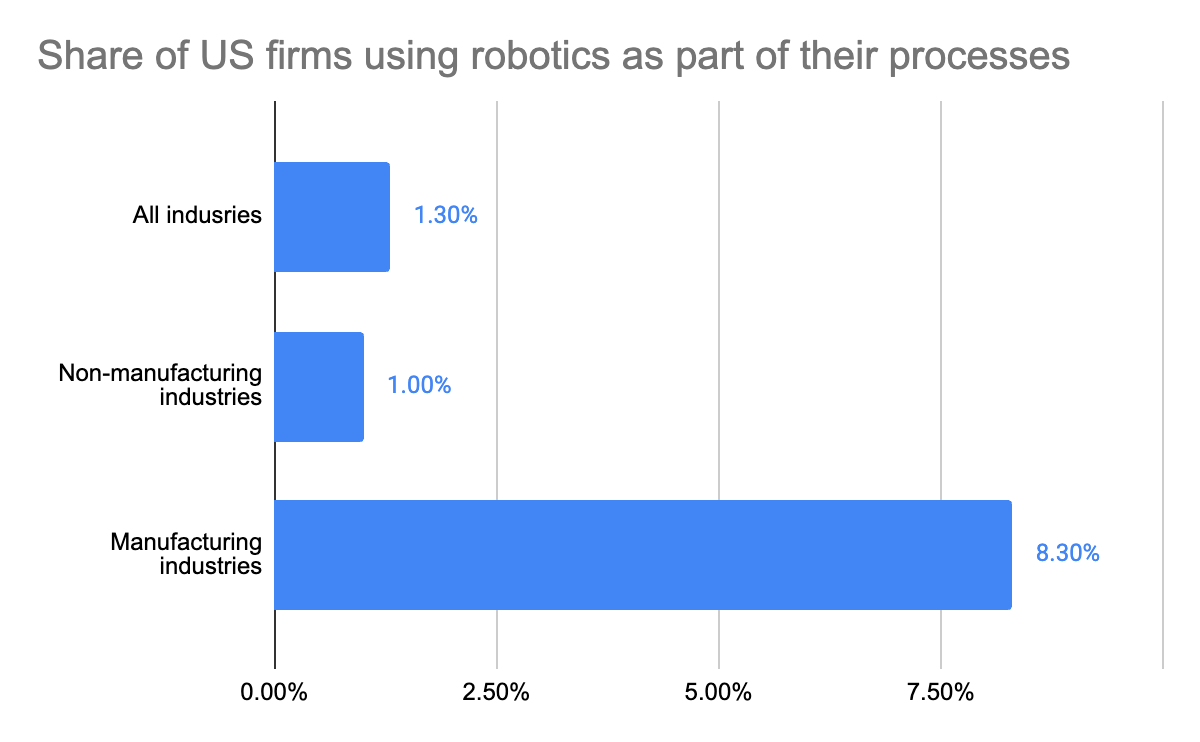
The reason: deployment complexity. No matter which robot or cobot they choose, Subject Matter Experts (SMEs) still have to integrate it with their legacy industrial stack, which means solving for PLC communication, real-time latency constraints, safety certification, IT/OT interoperability, and continuous tuning once systems are live.
If robots are to play a central role in the future of industrial AI (which I believe they will), we need to make it easier to deploy them in real-world settings.
The Opportunities
This integration gap is largely a learning problem and it shows up in four places, which are also opportunity areas:
1. How we integrate systems
Today, most deployments are one-off engineering projects – not just for robots, but for machines more broadly. At one Tier 2 auto supplier I visited while building my last company, a technician had worked there for over 40 years and was responsible for fixing machines when they broke and installing new ones. He knew the quirks of every system on the floor, and this knowledge lived almost entirely inside his head. Integrations were hard because if something broke, it all came down to this one man’s ability to find a fix. When I was last there, they hadn’t tried any robots – and weren’t open to exploring them yet.
But with physical-world models and high-fidelity sensing, integrating robots and new machines can actually be optimized like a learning problem. You can codify the integration process itself with parametric deployment templates, failure taxonomies, and configuration recipes that transfer across similar environments.
An integration system that learns would mean knowledge no longer lives just inside this one man’s head. Every time a robot or machine is installed or breaks, the system would record what failed, how it was fixed, and under what conditions. Over time, that knowledge becomes software: the next deployment starts with everything the last one learned, instead of from scratch.
2. How we simulate before deploying
Models are improving faster than our ability to validate them safely, so testing often happens on live production lines. Most “digital twin” systems are post-hoc mirrors of production, and aren’t actually good environments for safely validating deployments in advance. In order to de-risk deployments, simulation-native deployments are needed.
This means simulations that ingest sensor data, PLC timing signatures, conveyor variability, environmental noise, etc. Before a robot ever touches the factory floor, you’ve already tested thousands of failure modes: What happens when part orientation drifts by 15 degrees? When the upstream process runs 8% faster than spec? When lighting conditions change at 3 PM?
Over time, the sim-to-real gap becomes measurable, and can then be systematically compressed.
3. How we price outcomes
Integration is expensive because incentives are misaligned. When robots are sold as products, integration is an afterthought because it’s (naively) assumed to be a one-time hurdle.
But when you sell throughput, uptime, or parts-per-hour instead of the robot itself, you’re incentivized to automate and continuously improve deployment because it directly improves margins.
This is why RaaS and usage-based models are useful beyond being pricing mechanics. They create the conditions for learning systems to emerge. Long-lived customer relationships generate longitudinal data, which feeds better simulation, better deployment logic, and better long-term performance.
Some robotics companies have been moving in this direction for a while, but it hasn’t become mainstream because it’s financially risky. It requires deep operational expertise as vendors are now part systems integrator and part operator.
4. How we orchestrate robots, machines and humans
Most integration pain comes from trying to coordinate robots with humans, existing machines, safety systems, and production schedules. The opportunity here is around building orchestration layers for physical systems.
Instead of programming individual robots, these physical systems can work across an entire environment. They can assign tasks, adjust to disruptions, and collaborate with other robots or humans. For example, dynamically reallocating tasks between robots and humans when a line backs up, or reasoning about which robot should pick up a new job based on current capacity constraints instead of just task assignment rules.
This mirrors what’s happening in software: coordination comes before autonomy. Individual robots will first learn to collaborate with other robots and with humans on the factory floor, and then eventually autonomy will emerge at the system level.
The Surface Where Learning Happens
Robotics will eventually shape much of the industrial world. But to get there, deployments must be radically streamlined. Solving this deployment gap means treating deployment as a surface for learning which, in effect, makes integration a training problem rather than an engineering one.
Great post! Your point about the operational risks associated with more modern revenue models really resonated with me.
I saw a lot of SaaS companies got hammered in the public markets last month, and one explanation offered was that interest rates are now more dynamic, which affects the real value of their not-yet-recognized revenue.
Do you have a view on whether RaaS or usage-based revenue models are more attractive in today's economy?