

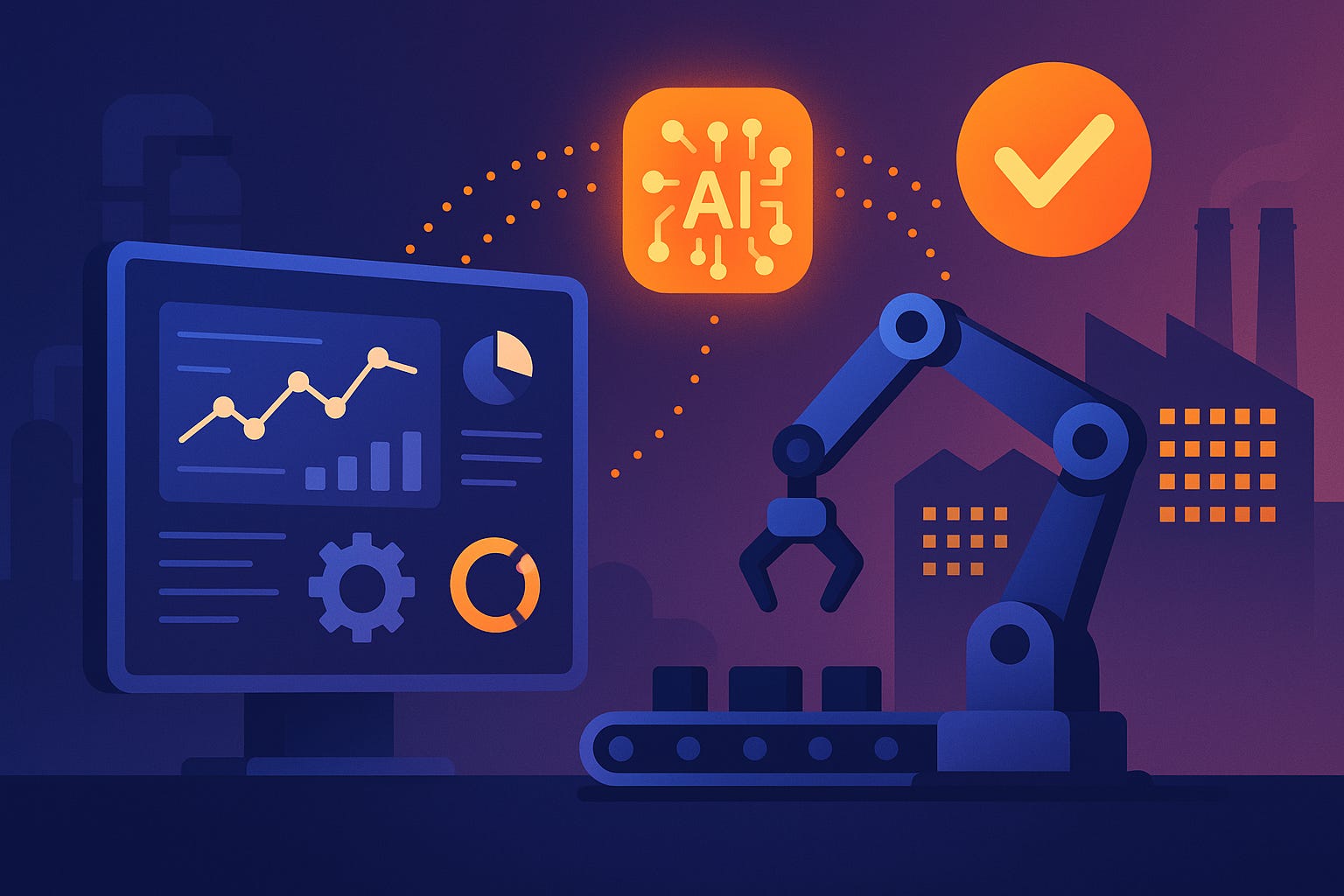
When I was building my last company, I spent a lot of time on factory floors. Owners of these factories almost always had a section of the floor dedicated to dashboards filled with near real-time data. In fact, most tours of the factory floor started with these dashboards. The factory owners understood that better data was key to optimizing processes and improving performance. But almost every one of them also acknowledged a gap – a growing disconnect between the data they were collecting and how it actually influenced decision-making.
In reality, most decisions were still driven by:
Reactive maintenance schedules
Fire drills when something broke
Decades-old heuristics or gut instinct
After exploring the broader industrial space more, it’s clear the problem is systemic and doesn’t just impact the manufacturing sector. For years, companies have tried to bridge the gap with dashboards and visualization tools. Now, with AI, abundant high-fidelity sensor data, and more accessible physics-based modeling, there’s a real opportunity for startups to go beyond visualization and start making the infrastructure itself intelligent. The incumbents aren’t built for this. Startups can be.
Where Legacy Falls Short
Before diving into where the opportunities are, it’s worth looking at why the existing solutions fall short.
Most of today’s industrial software wasn’t built for real-time, AI-native decision-making. Time-series historians like AVEVA PI System (formerly OSIsoft) compress or downsample high-frequency signals, silo data in proprietary formats, and require custom scripting to extract insights. SCADA and MES systems from OEMs like GE, Siemens, and Rockwell are focused on equipment control, not optimization or predictive insight. Their architectures are decades old, and while they’re reliable, they weren’t designed to support autonomous decision-making or edge intelligence.
Over the last few years, these incumbents have tried to retrofit AI into their stacks, adding bolt-on analytics or launching cloud platforms like Siemens MindSphere or GE Proficy. But these efforts still push the burden of integration, model-building, and ongoing tuning onto the customer. The platforms are often sprawling, complex, and slow to deliver value.
Enterprise data platforms like Palantir and C3.ai, meanwhile, offer broad and powerful toolkits, but require long implementation timelines and significant services work. Customers frequently struggle to scale deployments beyond initial pilots because these platforms demand extensive configuration, ongoing tuning, and a deep bench of internal resources. Mid-stage players like Cognite, SymphonyAI, and Uptake have made progress in contextualizing industrial data, but typically stop short of true real-time control, hybrid physics/ML modeling, or agentic optimization at the edge.
In short, legacy systems and the first wave of digital platforms are either too rigid, too generic, or too fragmented to meet the operational demands of modern industrial environments.
AI-Native Infrastructure for Industrial Decisioning
This creates space for startups to rethink the stack from the ground up, rather than simply bolting onto existing solutions.
AI-native platforms can distinguish themselves in a few key ways:
Stream high-fidelity data from sensors and control systems with ultra-low latency (e.g., microseconds)
Layer on hybrid models that combine physics-based simulation with ML
Embed pre-built, domain-specific agents (e.g., predictive maintenance, process optimization, or economic decision support)
Focus on usability and time to value, with near-zero onboarding, intuitive UIs, and API-first design
Wedge in without demanding wholesale replacement. In other words, coexist with PI, SCADA, and other systems and in time, earn the right to become the system of record
These foundations unlock a wide set of high-value applications:
Process Optimization: AI agents that continuously rebalance yield, energy use, and throughput in response to real-world changes (market conditions, raw material variability, or equipment degradation).
Anomaly Detection and QA: Real-time monitoring to flag failures before they happen, reduce unplanned downtime, and auto-generate compliance reports.
Techno-Economic Analysis: Tools that help teams evaluate operational or capital decisions (switching energy sources or adjusting run schedules) by simulating cost and performance tradeoffs.
Autonomous “Operators”: AI co-pilots that ingest thousands of signals, correlate them with contextual data (weather, ERP inputs, etc.), and make proactive recommendations.
Cross-Site Learning: Standardization of data across facilities to enable network-wide intelligence and faster rollout of best practices.
There’s room here for focused players to break out, especially those who deliver faster deployment, deeper domain specificity, and AI that works out of the box. The key here isn’t just about streaming data or generating insights, it’s now also about closing the loop to help operators act faster and more confidently in environments where the margin for error is thin.
Turning Data into Operational Intelligence
Industrial firms don’t need more dashboards. They need help making decisions: when to act, where to optimize, how to adapt.
That’s the promise of this new generation of industrial AI startups: building systems that go beyond visualization to simulation, prediction, and prescription. In an industry where seconds matter and insights degrade fast, the winners will be the platforms that think and act, in real time.
Near-zero onboarding is the interesting challenge