

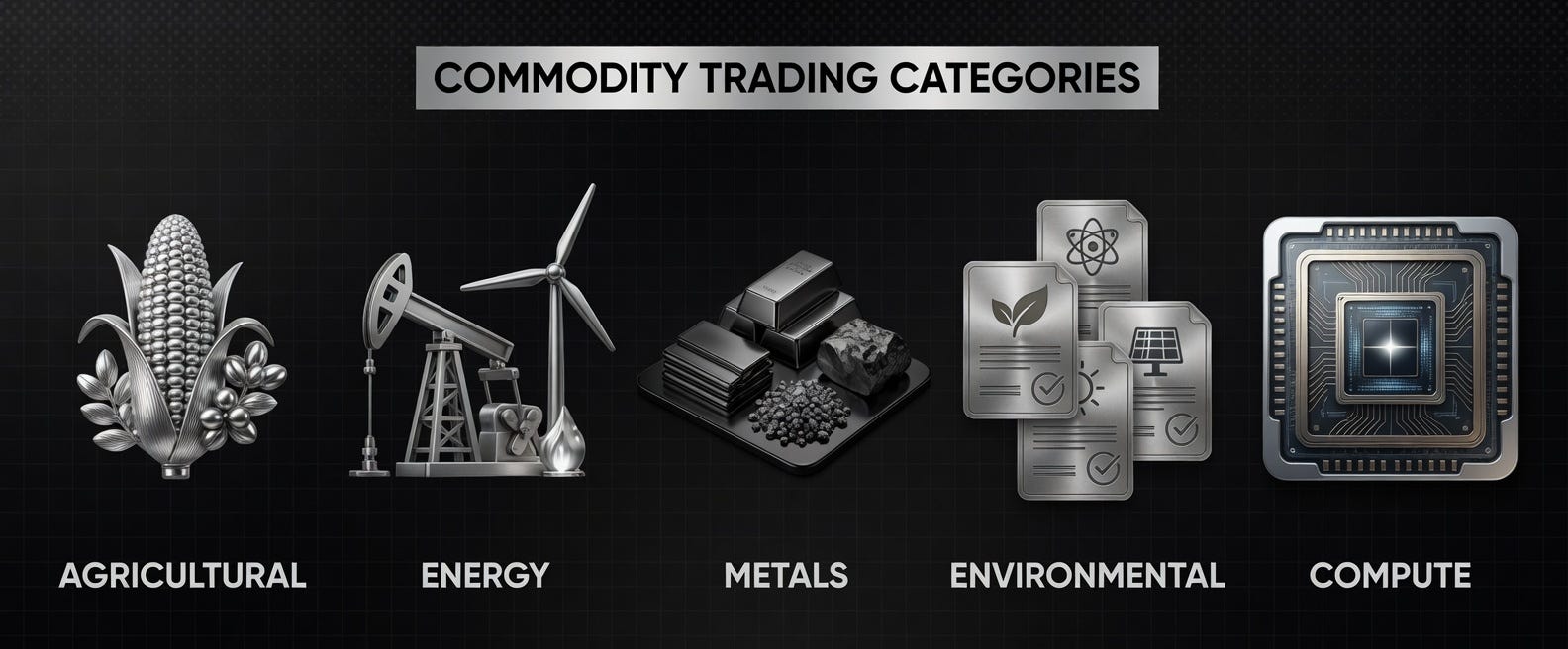
We’re still living in a supply constrained market for compute. But my belief is that compute will become a commodity, just like oil.
And just like oil, we need market infrastructure to enable a liquid market for buyers and sellers of compute to transact. If you want to understand what a mature compute market could look like, look at what every other commodity market became.
ICE and CME, two of the world’s most important exchange operators, are worth approximately $91 billion and $104 billion respectively today. S&P Global, whose Platts business helps provide benchmark pricing across commodity markets, is worth about $134 billion. MSCI, which built a powerful index licensing business around becoming a benchmark layer for public markets, is worth about $42 billion.
I recently sat down with Wayne Nelms, the CTO of Ornn, to talk about where he sees the future headed for compute. “Turning a megawatt into a token is very hard. It’s not very efficient,” he told me. That inefficiency is the path from raw infrastructure to useful AI output. It’s a wild west. And wild wests, historically, have been where the most valuable financial infrastructure gets built, bringing order to chaos.
The current market
The chain to compute starts with whoever owns the land. Then the data center builder. Then the lenders, who provide the capital that makes the build possible. Then the neocloud tenants who lease the facility. Then cloud service providers who resell to enterprises. Then the AI companies that turn that compute into tokens. Each link in the chain is looking at the one next to it and asking: can I trust this end user to actually pay?
“It’s like in commercial real estate, the person who builds the apartment building is leasing it to a landlord, and the landlord has some operational exposure. The landlord only cares about the creditworthiness of the end resident,” Wayne said. “The problem is that (for AI infrastructure) most of the residents are new.”
“We have all these companies that aren’t even a year old that have huge computing needs. They’re effectively the equivalent of a new grad in New York looking to rent an apartment without a guarantor.”
The only way anyone gets a data center built today is if a hyperscaler steps in as the guarantor. They’re the parents co-signing the lease.
This doesn’t scale, and it’s also becoming more and more fragile.
Hyperscaler balance sheets are not infinite, and they are not aligned with the rest of the ecosystem. These companies have their own agendas. They’re selfish, as they should be. And as some of them approach public markets or manage investor expectations around capex, the pressure to throttle their guarantor role is intensifying.
“Private credit firms are becoming more particular about the loans they give, even to some of the most well known AI companies.” And if that’s happening at the top of the food chain, imagine what’s happening below it.
“If smaller players go to a data center, they’re just going to get laughed at. They don’t have enough money on their balance sheet or creditworthiness.” Not to mention, there aren’t options to rent just for one year so most have to lock in for 3-5 years, which is basically impossible for these new entrants.
The structural mismatch
The market today has a structural mismatch: there are essentially two tranches that can’t meet each other.
On one side, you have investment-grade supply (hyperscaler-backed data centers) fighting over a tiny pool of investment-grade buyers. Every major data center developer is trying to lower their rates to win deals with the same handful of hyperscalers. “Everyone is asking, how can I make my rates more attractive so Google will buy? So, Google has huge pricing power right now,” Wayne said.
On the other side, you have non-investment-grade everyone else. Smaller data centers who can’t get tenants because no one trusts them. Smaller AI companies who can’t get capacity because they can’t sign five-year offtakes.
“None of these buyers trust these sellers, and vice versa; the only thing the low-tier demand wants is the high-tier supply,” Wayne summarized.
Two paths to a market
There are two ways to close this gap, and any mature commodity market has both of them.
The first path is to make the long tail of demand creditworthy. You can do this by aggregating demand, rating it, packaging it into diversified baskets that as a whole look financeable even if individual buyers don’t. This is the securitization playbook: take something that doesn’t qualify for capital on its own and structure it into something that does.
The second path is to institute hedges. Build an on-demand market, publish reference prices, launch futures and derivatives so that data centers, neoclouds, and lenders can protect themselves against adverse price movements. This is the commodities playbook: if you can’t eliminate the risk, you can at least price it and transfer it.
Today compute has neither path available at scale.
Building trust through risk mitigation
To create these paths, compute needs risk mitigation tools: benchmarks, futures, residual value guarantees, and credit enhancement via aggregation. These are the same things that turned oil and equities from illiquid, bilateral markets into the deepest, most efficient markets in the world.
“It’s all about trust. We have to make it a safer investment. And how do you do that? You have to provide risk mitigation tools,” Wayne said.
One objection I hear when I talk to people about this opportunity is that GPUs aren’t fungible enough to benchmark. Every cluster is unique due to different hardware generation, different networking fabric, different power density, different location, different reliability. How can you publish a single reference price for something that varies so much?
But this is no different from any other commodity. “Oil, Silver and gold, wheat. They all have different grades. Of course GPUs are arguably more different, more like a snowflake, so to speak, than any other commodity class,” Wayne said. But that just means you define minimum specs and index within those bands.
“We don’t have to worry about making it the most granular index in the world. We just want to make a good enough one,” Wayne said. Adding that, “this might sound counterintuitive, but it just needs to be good enough to facilitate any risk mitigation and management.”
In other words, the goal is to build a reference point against which two counterparties with different exposures can transact.
There’s an alternative approach some are trying, which is to force fungibility by abstracting away all the granularity (aka treating every H100 as interchangeable regardless of where it sits or what it’s connected to). I don’t think this is the right approach because you abstract away too many details such that buyers can’t specify their actual needs.
What the end state looks like
There are, of course, companies doing variations of this today. Nvidia is the most obvious one: through its guarantor role, it’s effectively underwriting the market. But they aren’t the long-term solution. The infrastructure layer in any commodity market has to be neutral. A compute market owned by Nvidia would never be trusted by AMD, just like a benchmark owned by a hyperscaler would never be trusted by the neoclouds it competes with. And as for the incumbents like S&P and MSCI, they don’t have the data, the neocloud relationships, or the transaction flow. I think they’ll eventually acquire their way in, but they’re not going to build this from scratch.
There is thus an opportunity to build neutral market infrastructure for compute, which will follow a similar path as other commodity markets.
Compute will eventually become a more liquid market where capacity is procured on demand rather than primarily through long-dated bilateral contracts. Reference prices will be published continuously. Secondary markets will emerge for unused reservations. Credit-enhanced baskets will help smaller AI companies access top-tier supply.
According to Wayne, to make this happen, “it’s ultimately about building trust in the market.”
Author’s note: An LLM was used for light copy editing only (spelling, grammar, and clarity). Content, meaning, tone, and structure remain unchanged.
Compute futures will benefit this entire line of risk hops. The race to market will be intense for hedging tools.
You should check out SF Compute (Evan Conrad).