

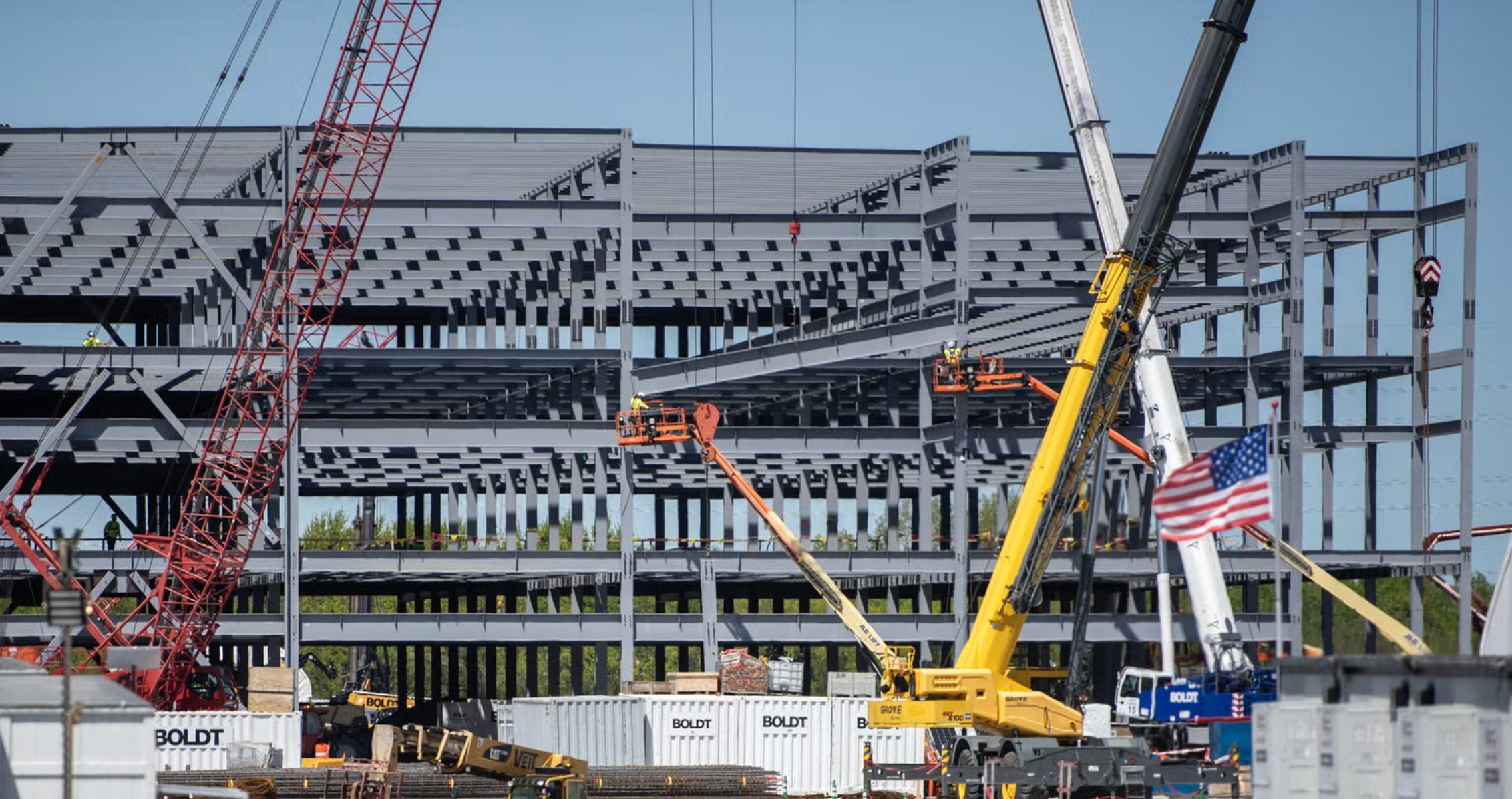
The Mag Seven’s 2026 capex guidance is larger than the Apollo moon program, the transcontinental railroad, and the interstate highway system combined.
I sat down last week with Brexton Pham, Global Co-Head of Compute Infrastructure at Cantor Fitzgerald to talk about this buildout and where he sees the opportunity. Brexton has a unique perspective because his mandate spans the trifecta of power, land, and capital. As Brexton put it, they’re set up for “tackling humanity’s largest ever infrastructure efforts.”
And we’re still very early. By his count, worldwide internet penetration sits at around 75%, while worldwide AI penetration is “maybe 15% if I’m being really generous. And that 15% is also primarily the layman’s ChatGPT usage.”
The buildout is enormous and has barely started. The hyperscalers and the nation-states are committing tens of billions to capex. As the buildout progresses, it is increasingly opening up new categories of opportunity.
The wrong filter, and the right one
“We are entering this world where verticalization matters more than ever and anybody can build anything much faster,” Brexton said. In other words, it’s very hard to predict what the hyperscalers will and won’t do, and it’s only getting harder.
Anything that looks like an unguarded seam today can be swallowed tomorrow. “You should assume your competitors can verticalize overnight,” he said. Behind-the-meter power, nuclear, on-site generation all looked non-core to a hyperscaler a few years ago, but they are now moving directly into these categories.
“When OpenAI and Anthropic first came out, everyone, including myself, assumed that they were AWS-shaped. They were platform-shaped, in that they would never cannibalize their own customers. And boy were we wrong,” Brexton said. “We have never seen customer cannibalization to this scale before. But that’s on the software side. Physics is much harder.”
“The decision to own physical assets,” he said, “to own land, to own a building, to maintain it, to build equipment, to sell equipment. It is significantly harder than software.” These physical seams create differentiation and durability over time. They are more resistant to verticalization because the constraint is physics and time.
And as AI infrastructure scales, the economics of these physical seams change as well. Data centers themselves were considered low-margin, Brexton pointed out, until AI data centers came along: “AI data centers are extremely high margin; inference is very high margin.” Whether that holds across every workload is debatable, and margins vary by model and use case. But the reflexive belief that owning physical assets means accepting thin margins is, in his view, a holdover from the pre-AI world.
So if physical difficulty is the moat, here’s my rough map of where the non-hyperscaler opportunities are the most compelling:
Opportunity 1: Energy Aggregation
Power is one of the binding constraints on the entire buildout. “It doesn’t matter how many chips you have if you don’t have the literal powered land for it,” Brexton said. The hyperscalers know this, which is why they’re now investing directly in generation via nuclear restarts, SMR offtake deals, on-site power.
But there’s a difference between owning the power and assembling it. “If I’m a hyperscaler, do I actually want to do the work of aggregating behind-the-meter power? Probably not,” Brexton said. Hyperscalers obviously care a lot about power, but the aggregation work itself to get that power requires sourcing and permitting on-site generation, wiring in storage, negotiating with landowners and local utilities, etc. These are all areas that hyperscalers would rather buy the result than build the capability.
There are companies that are already running at this: American Terawatt on the behind-the-meter side; and Aalo Atomics, Valar Atomics, and Blue Energy on the nuclear side. “Obviously the hyperscalers aren’t tackling nuclear” at the build level, Brexton said. “Why would they?”
Aggregating distributed power, siting and operating reactors, and building generation are bound by interconnection queues, regulatory timelines, and physical construction. These are hard physical problems and thus the solutions for them are more defensible.
Opportunity 2: Resilience Infrastructure
The supply chain underneath AI is fragile. And during the recent Iran war when multiple Azure and AWS data centers in the Gulf states were attacked, we got a glimpse at just how fragile it actually is. The analogy here is the cybersecurity build-out of the 2010s. Before Stuxnet, essentially nobody was paying for OT security. The Iran data center strikes may be a similar inflection point.
As Brexton put it: “We have clearly entered a world of asymmetric economic warfare. They were able to counter our multi-million dollar rockets with drones that cost maybe $10,000. We’re supposed to have the most powerful military on earth, but they were throwing toys at our missiles.”
And the exposure isn’t confined to the data centers themselves. Our vulnerabilities stretch around the globe:
Rare earths, which power semis, are basically monopolized by China today.
ASML, the only company on earth that makes EUV lithography machines, is in the Netherlands.
TSMC is in Taiwan. “If Taiwan got invaded tomorrow,” Brexton said, “it would be a very, very scary thing.”
Intercontinental sea cables carry trillions of dollars of data packets every day. “Cut them, and you cripple economies overnight,” Brexton said.
The Strait of Hormuz, where roughly a third of seaborne oil passes. “We were wildly exposed with the Strait of Hormuz,” he said. “And we still are.” And there are other choke points like the Strait of Malacca, Bab el-Mandeb and the Suez, the Taiwan Strait, the Panama Canal and the Turkish Straits.
Each one of these is a single point of failure that no operator can fix on their own. Therefore, hardening AI infrastructure is equally as important as building it in the first place. Some of sub-categories here include:
Redundancy and failover software for compute and data pipelines
Alternative routing infrastructure for when sea cables get cut or regions go down
Supply chain visibility tools so operators can see, in real time, which inputs are getting squeezed
Physical site monitoring and threat intelligence designed for industrial-scale AI facilities
Insurance products and financial instruments that let operators hedge geopolitical risk in their compute supply chains. This is a category that didn’t really exist five years ago and is now being underwritten by Lloyd’s and a handful of specialty carriers
The buyer profile here is broader than the other categories because nearly every AI company needs resilience tooling.
Opportunity 3: Space
The commercial case for moving data centers off Earth comes down to escaping the constraints throttling terrestrial build-outs: land, grid, permitting, and politics. Ben Thompson had a great piece the other day about data centers in space. Two points from that article stand out. First, data centers in space can look wildly different from data centers on Earth. They can be satellite-sized compute racks interconnected with lasers, each with its own solar power and radiator arrays. Some examples of companies building here are Starcloud (formerly Lumen Orbit), which has already flown an Nvidia GPU in orbit, and Kepler Communications, which is operating what’s currently the largest in-orbit compute cluster, a handful of edge processors linked by laser.
Second, and more importantly, Thompson points out that agentic workloads don’t need the low latency that human-facing inference requires. This makes them uniquely well-suited to orbit, where round-trip latency is higher but land, grid, and permitting constraints basically disappear. Cooling doesn’t disappear, though and constrains how big these systems get. In vacuum there’s no air to carry heat away; you can only radiate it. An example of a company trying to solve this is Sophia Space, which is building thin tile-shaped satellites that sit processors against a passive heat sink to kill the need for active cooling.
Beyond the commercial cases for space, there’s also a national-security one. “If you buy into the belief that a lot of the supply chain will be considered critical infrastructure,” Brexton said, “then you can also imagine that we will move more critical infrastructure into space as a consequence of our desire to enhance national security.” From there, “the argument for space data centers becomes very compelling, the argument for in-orbit manufacturing and in-orbit refueling becomes very interesting.”
Examples of companies in this servicing layer are Starfish Space, which is building a satellite servicing vehicle, and Infinite Orbits, which is focused on satellite life-extension and inspection. Assembling, refueling, and repairing orbital infrastructure is a hard physical engineering problem with long lead times.
Opportunity 4: Labor
One of the top reasons build-outs get delayed is that, in Brexton’s words, “we straight up don’t have enough electricians and data center operators.” As I wrote about a few weeks ago in my conversation with Ben Pouladian, Jensen Huang has said the same thing: the bottleneck he’s most worried about is the shortage of plumbers and electricians.
There are really two constraints here. The first is raw supply: there aren’t enough skilled people, and training them takes years. The second is location: even where the people exist, they’re rarely near the build sites. “Abilene, Texas for example has a lot of powered land and is a very obvious place for large industrial build-outs,” Brexton said. “But it’s in the middle of nowhere. So you’re asking families to relocate to a place that doesn’t have affordable housing or much of a residential area.” This is an issue of proximity to some extent and it exists across the entire supply chain: “If I break a part this afternoon, I can get a new part the next morning in Shenzhen, whereas in the US I’m waiting six weeks,” he said.
In my conversation with Saman Farid of Formic we talked about this same problem. He framed US industrial weakness as a utilization problem: a typical US factory runs far fewer of its available production hours versus a Chinese one, so the same building and equipment yields a fraction of the output. The problem is we can’t just solve this with more labor because we don’t have access to more labor.
So the opportunities split across doing more with the workers you have, and reducing how dependent a site is on workers being nearby:
Robotics and automation to enable on-site construction, electrical work, and manufacturing
Workforce creation via accelerated credentialing, apprenticeship-to-placement pipelines, and staffing built specifically for data center construction
Remote operations and lights-out facility management that reduce how many people a remote site needs on the ground
Each of these is a way to solve the physical constraints around the labor problem.
The Foundation of the Intelligence Economy
There’s one constraint that we haven’t talked about yet, but it gates all of the categories above: public sentiment. Municipality pushback is already causing build-out delays, and it’s only increasing. “The average American,” Brexton argues, “is meaningfully more anxious about AI than excited, and Silicon Valley keeps underestimating that anxiety.”
Some of that anxiety is misinformation. He traces the water-usage panic to a figure in Karen Hao’s Empire of AI that overstated data-center water use by a large factor and was later revised, “but the damage was already done.” Some of it isn’t. Either way it exists, and it’s yet another hurdle to confront as the buildout proceeds.
This hurdle further stymies the physical buildout, which Brexton believes we’re still “severely underestimating in order to power 24/7 demand of intelligence.”
The easy conclusion is that this entire map will be drawn by giants: hyperscalers, nation-states, utilities, and the capital providers large enough to finance the buildout. Or, on the other side, that public backlash will slow the whole thing down before a new startup ecosystem can form around it.
I don’t buy either. The hyperscalers will define much of the demand, and public sentiment will shape where and how fast the buildout happens. But neither eliminates the startup opportunities, which I believe are largely physical and can’t be verticalized overnight. And while some of these opportunities may look like narrow seams today, over time, they will become part of the foundation that the intelligence economy depends on.
Author’s note: An LLM was used for light copy editing only (spelling, grammar, and clarity). Content, meaning, tone, and structure remain unchanged.