

A lot of industrial AI is framed around visible tasks. Can a system inspect a part, sort an item, move an object, classify a defect, or complete a step that a human used to do manually?
These are exciting opportunities, but they are just a fraction of what’s possible. Some of the most important industrial problems are not visible from the outside.
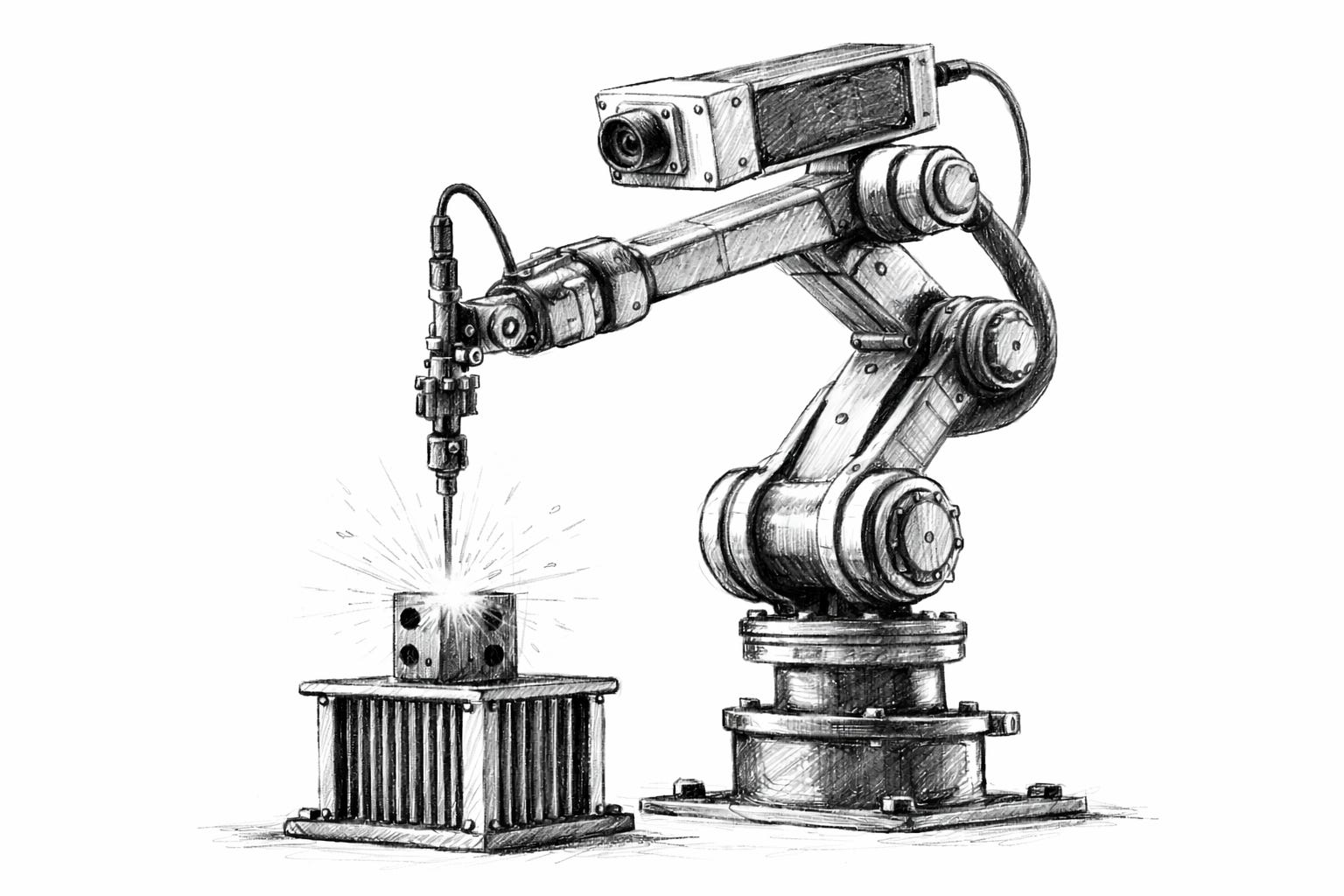
This past week, I explored this idea with Angus Muffatti, one of the founders of Gradient Robotics. On the surface, Gradient looks like a welding robotics company. But Angus describes the company differently: “We’re trying to build metallurgy AI rather than welding AI. The goal is to understand the material behavior in order to know whether the welding process actually worked.”
To understand the material behavior, you need to understand the interaction between material, heat, geometry, and execution. This requires learning to model the hidden structure of the process.
Binary vs. Continuous Problems
Angus framed this as the difference between binary problems and continuous ones.
Some industrial tasks have outcomes that are binary. Did you put the product in the box? Yes or no. The success criteria is easy to verify. A system either completed the task or it did not.
But welding is not like that. “It’s a continuous problem where there’s an infinite range of how good a job was done between zero and one,” Angus said. “A weld can look acceptable on the surface, but actually be terrible.” The success criteria are buried in the interaction between different properties of the material.
“A human welder is inferring what’s happening inside the material they’re putting together. They are interpreting signals and making adjustments based on things they usually can’t observe directly,” Angus told me.
In other words, surface appearance isn’t enough.
This idea extends beyond welding. A part may pass a visual check and still fail under certain stress. A polishing process might hit the target finish while thinning the material too aggressively. A machining process might maintain throughput while accelerating tool wear and increasing variation over time. A welding system might produce seams that look acceptable to the eye while weakening fatigue life or introducing defects that only show up later. In each case, the visible output can look correct even if the underlying process drifts away from what actually matters.
“A lot of the near-term excitement in industrial AI clusters around the binary problems. But some of the deeper opportunities are around solving the continuous problems,” Angus believes. This requires learning what is happening inside a process well enough to intervene intelligently.
Why Welding Is a Useful Test Case
Welding is a good lens because it concentrates many of the core challenges of industrial AI in one place. It is labor-constrained, skill-constrained, quality-sensitive, and tightly tied to production outcomes in many industries. The cost of getting it wrong is high.
As Angus told me, “Welding makes up something like 2% of skilled trades, but around 30% of the shortage. Every year, there’s a gap of about 80,000 welders. Attrition is responsible for about half of this, and then increase in demand is responsible for the other half.” According to the American Welding Society, there is currently a welder shortage of over 400,000 people (source). That makes automation in welding different from the labor automation caricature people sometimes have in mind. The challenge is if and how the industry can maintain output in the face of a shrinking labor base. “If our robotic systems can just keep up with the gaps in this skilled trade, that would barely be enough.”
At the same time, the economic tolerance for quality slippage is extremely low. “If your scrap rates on 100 parts are higher than two, you start to mess with the ROI calculation.”
And because the quality data is hidden inside the physical material, the data mandate looks very different from digital AI. “The data mandate is 10 to 100 times harder,” Angus told me. In digital systems, the signal is often already captured in logs or text. In continuous industrial systems, the relevant signal is hidden inside a physical process or physical material.
That changes what “data collection” means. It may involve thermal cameras tracking heat distribution during welding, machine-vision systems monitoring the weld pool geometry, current and voltage traces from the power supply, force, torque, vibration, or acoustic signatures from the process itself, and downstream inspection data such as X-ray, ultrasound, CT scans, metallography, tensile testing, hardness measurements, or chemical and microstructural assays. And in some workflows, the highest-value signal appears only after the part is run in the field.
This makes the data problem hard. Data collection is slower and getting the ground truth may require destructive testing or long feedback cycles. Labeling is harder too because “good” isn’t usually a single binary outcome. The target itself can also be contested: are you optimizing for immediate yield, cosmetic quality, structural integrity, throughput, or lifetime performance in the field?
Even simulation is less useful than outsiders assume. “The simulation fidelity isn’t good enough yet, and traditional FEA approaches are insanely expensive and too slow to run in a production environment. They also assume idealized materials, whereas the real world is much more complex,” Angus told me. “However, this is something we’re actively working on solving.”
By comparison, some categories of robotics look much easier to get off the ground. “Pick and place is the kind of thing you could probably train in an afternoon.” Here, the prototype path is shorter and progress is easier to show versus in continuous problem categories where progress tends to be slower and harder to visualize.
“But once you can do it, it becomes a significant moat,” Angus believes.
This is a pattern that shows up across AI more broadly. The most defensible opportunities are often the ones where the learning loop is hardest to build and the ground truth is hardest to extract.
Participating in Judgment Before Replacing It
That also helps explain why autonomy in these environments usually has to be earned gradually.
“We didn’t get in the car and take our hands off the steering wheel on day one,” Angus said. “Similarly, we’re not going in and promising the end-to-end complete process.”
Part of that is technical. Part of it is cultural. In many manufacturing environments, systems like welding are tightly tied to product quality, customer trust, and institutional identity. “For a lot of manufacturing businesses, welding is their core competency or a part of their core competency.”
That makes full abstraction emotionally and operationally difficult. “A company coming in and saying, forget about your core competency, let us take care of that, generates an allergic reaction,” Angus said. And in many cases that reaction is rational. “They want to be in control of the quality output of their products because that’s their reputation.”
So the better model is staged deployment. Start with something useful. Help the operator. Improve consistency. Improve quality. Preserve the ability for a human to intervene, correct, and shape the process. “Fundamentally our job is to just make a better machine. Don’t remove the ability of the operator to correct and edit things. This also makes the system better because you learn from those corrections.” Over time, the product gets better and trust builds – and eventually, more of the system can become automated.
The AlphaFold Parallel
There is a precedent for this kind of shift in other fields. In bio, one of the biggest leaps came when systems got better at inferring underlying structure. AlphaFold predicted the three-dimensional structure of proteins from their amino acid sequences, which helped researchers infer a property that had previously been difficult and expensive to determine experimentally. This changed what kinds of questions researchers could even ask, and unlocked enormous downstream value by accelerating the discovery of new medicines and treatments.
Industrial AI may require a similar move. In many industrial processes, the important variables are buried in material behavior, process dynamics, tolerances, and physical interactions that operators learn to infer through experience. In those environments, there’s an opportunity to recover the hidden state of the system well enough to understand why outcomes happen and what to change. That, in turn, has the potential to unlock significant downstream value.
“More focus should be paid to these really deep problems by understanding the physical nature of reality within that specific process,” Angus said. “This means doing the hard work to extract that data, then training models on top of that.”
It may be a slower path, but that is often how the deepest technical understanding gets built.
Author’s note: An LLM was used for light copy editing only (spelling, grammar, and clarity). Content, meaning, tone, and structure remain unchanged.
The data capture required to design for industrial robotics is heavily underestimated. The complexity is certainly higher for welding but even pick and place jobs can have dozens of material properties with distinct process steps in and out of the cell that need to be captured and organized for a well designed solution
This is one of the better articles that describes why AI in Manufacturing is hard, but with a potential for a huge impact when gotten right.