

Inside a tokamak, plasma circulates at temperatures around 100 million degrees, hotter than the core of the sun. Nothing can contain it by contact, so it’s held by magnetic fields, shaped and reshaped in real time so the plasma never reaches the wall. “It’s like you want to control a storm in a very small area, without letting this storm touch any wall.” Azarakhsh (Aza) Jalalvand, a research scholar in Princeton’s Plasma Control Group explained to me the other week when we sat down.
Aza’s training is in computer science and AI, not fusion. His PhD was on speech analysis with neural networks, later extended to image, video, and radar data. He ended up focusing on fusion almost by accident: a professor from the applied physics department turned up at his data science lab with a pile of data from a fusion device and a request for volunteers.
What Aza found was a field that had made remarkable progress over decades, but was still challenging due to the complexity and nonlinear behavior of plasma. “Physicists have brought us a very long way,” Aza told me. “But plasma is an extremely complex environment, and our current knowledge and models are not fast or accurate enough to predict its behavior reliably in real time, which makes monitoring and control hard. It also means we still have to rely a lot on experimentation and trial and error.”
Today, researchers have to rely heavily on sensors to estimate the plasma state and guide control decisions. Sensors provide the essential measurements of what the plasma is doing, and there’s no computational substitute for them because existing physics models can’t yet predict plasma’s behavior with sufficient speed and accuracy.
But sensors fail.
This problem is not specific to fusion. Any system with a lot of sensors (such as a satellite, a factory line, a patient monitor, etc) will eventually lose one. When that happens, everything that relied on that reading gets worse. In a well-understood system you can calculate around the loss. But when the underlying theory can’t predict the system, such as is the case in plasma, there’s no way to calculate what the dead sensor would have read. Measurement via the sensor was the only route to that number, until Aza and his colleagues built a workaround. And in doing so, they also ended up discovering measurements no instrument had ever been able to make.
In our conversation, we talked about the work that led to this breakthrough, how you trust a signal that was never recorded, and what it means when a model produces a measurement no instrument could.
Diag2Diag: its origins and applications
“If you talk to a physicist or a diagnostician and say, ‘Diagnostic A died. Is it possible to make its measurement by looking at diagnostic B and C?’ the simple answer is no,” Aza said. “And that’s correct. They are measuring totally different things. But for me, I’m an engineer, I’m a data scientist,” he said. “All these sensors are looking at one system.”
So even though diagnostic B might not measure what diagnostic A measures, the information could still be there, distributed across the other signals in a form nobody can make sense of.
“Maybe AI can find this pattern,” Aza said. “This is where machine learning and AI shines, because these models are very good at learning and leveraging patterns that cannot be interpreted by our understanding.”
A model can learn the relationships between sensors from historical data, assuming enough of the data exists from periods when every diagnostic was running. This means that when one sensor drops out, the model can generate a synthetic version of its signal. That idea became Diag2Diag (Diagnostic to Diagnostic).
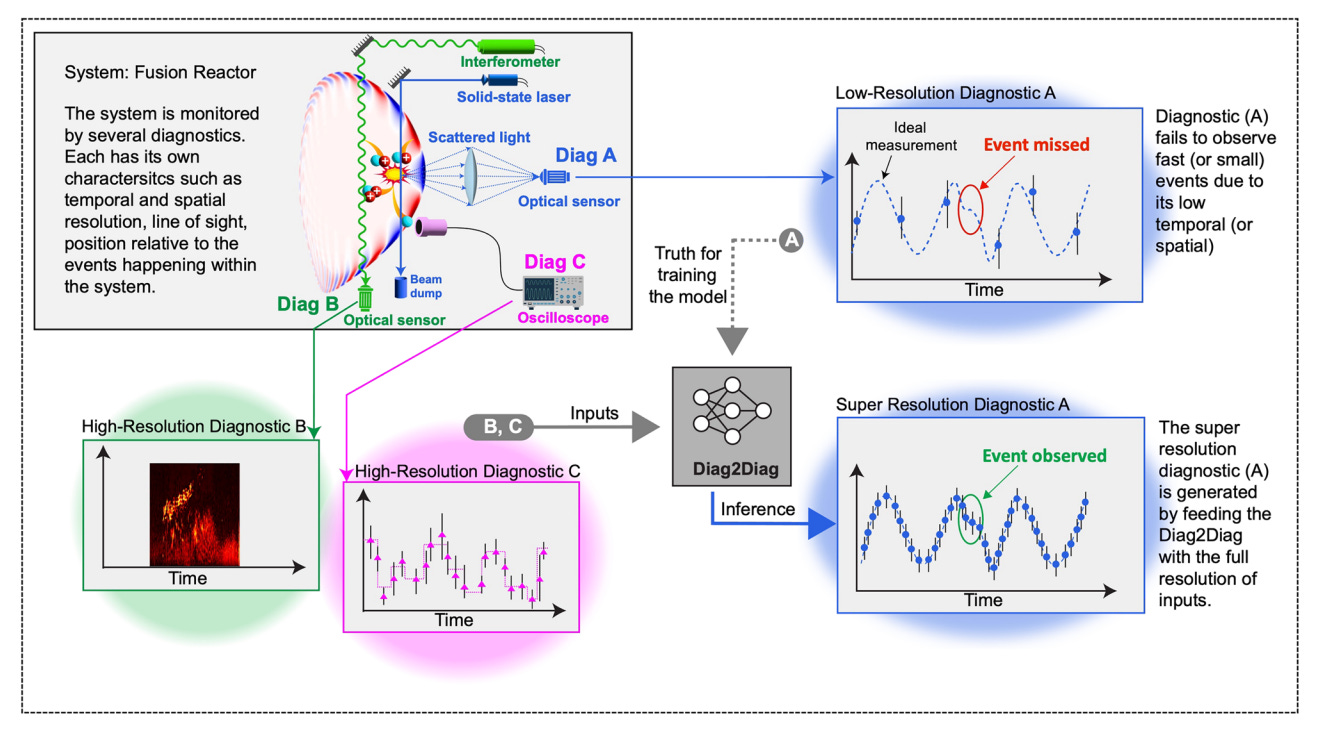
The paper describes an experiment where the model is given data it hasn’t seen and asked to reconstruct a signal that was actually recorded. Its predictions are checked against what actually happened.
“We can compare and say, okay, now it’s correct, or now it’s wrong, or it’s 90% accurate,” Aza said. He added a caveat, “a model can be 90% accurate but with a lot of uncertainty. That’s also important.”
Much like any hardware sensor, the reconstructed signal is checked against known answers enough times to establish what its errors look like. After passing this validation, the model is used on live experiments.
The immediate application for this is failure mitigation.
“Whenever we have a tough system in which maintaining the hardware, maintaining the sensors, is expensive, time consuming, or even impossible,” Aza said, “synthetic measurements become interesting.”
He gave the example of a Mars rover. When a sensor dies, no one can easily fix it. But the rover has years of history from that sensor alongside all the others, and so those relationships can be learned and used to predict the missing signal.
The same idea can be applied in a lot of settings, especially where the sensors might be hard to reach such as on the seafloor, inside jet engines, in concrete, orbiting, or implanted. Like anything in AI, how well it works depends entirely on the data. “It all depends on the quality and the quantity of the data that we have collected historically,” Aza said.
AI as a new instrument
Diag2Diag was built for sensors that fail. But a sensor can be missing in another sense: it can be working perfectly and still not tell you what you need, because its measurements aren’t granular enough.
For example, Thomson Scattering is the diagnostic that measures electron temperature and density, two of the quantities physicists care most about. It fires a laser into the plasma and reads the light that scatters off free electrons. It’s also not fast enough to measure under millisecond plasma events researchers actually want to see.
So Aza’s team wanted to see if they could use Diag2Diag to reconstruct Thomson Scattering. The other much faster diagnostics became the inputs, and Thomson’s readings became the target the model learned to reproduce. Unfortunately, the model can only learn at the instants when Thomson Scattering happens to take a reading, and those instants are few and far between. This means that most of the data can’t be used.
“For example if Thomson Scattering fires at every 5 milliseconds, during training we just ignore the input data of the other diagnostics at milliseconds two, three, four, five, because we don’t have the target measurement,” Aza said. “Then we thought: what happens if after training the model we give [the model] those inputs where we don’t have the data from Thomson Scattering anyways?”
However, because there is no Thomson Scattering reading at those intermediate moments and never was, there is nothing to check against.
“That is where the data-driven validation stops,” Aza said. “We cannot do any data validation anymore. Now we have to think about physical analysis. Do these measurements physically make sense?”
This turned out to be answerable. Edge localized modes (ELMs) are eruptions at the edge of the plasma that occur when the pressure gradient builds past what the edge can hold. Aza described the approach to mitigate them to me like tapping a balloon, “the surface flattens for a fraction of a second, then springs back”. ELMs are one of the things Thomson is too slow to catch; Thomson Scattering samples on the order of milliseconds, but an ELM happens much faster than that. So a reading only happens by chance, and never enough times in a row to see the shape of the event.
Physicists had a theory that structures called magnetic islands suppressed ELMs, and they ran simulations to predict what the electron profile should look like as an island forms. The theory had no experimental confirmation because there were no instruments fast enough to validate it.
“I worked on the data and generated some outputs, but I didn’t know if they were physically meaningful,” Aza told me. So he gave them to a physicist who ran the simulations and confirmed they were a good match. In other words, the synthetic measurements, generated at moments when no hardware recorded anything, matched the simulations. “This was a very good example of an unbiased discovery,” Aza said.
AI wasn’t analyzing observations that a sensor had made. It was actually producing net new observations that no sensor had ever been able to make before.
What this changes
AI systems are already good at answering questions we know how to ask. Is this a hand? Is this signal abnormal? What is the predicted value of this measurement? But science often advances when someone notices the thing nobody was looking for.
“These AI models have been really good, sometimes almost perfect, in answering the questions that we know,” Aza said. “But in plasma fusion, the question is: what are we missing?”
Normally, answering questions we don’t know requires building new hardware to generate new data. But here it didn’t and that’s what makes this result so unusual. The evidence for the magnetic island theory was latent in data the machine had already recorded.
Potential future applications extend beyond plasma to aerospace exploration, robotic surgery, and any complex engineering or scientific systems where missing measurements can compromise safety or control.
Diag2Diag started with trying to answer what happens when a sensor is missing, broken, or too slow. But it led to discoveries much deeper. AI may not only help scientists analyze the world, it may help them observe it.
Author’s note: An LLM was used for light copy editing only (spelling, grammar, and clarity). Content, meaning, tone, and structure remain unchanged.