

When the iPhone app store launched, it wasn’t clear at the time how or even why hundreds of thousands of apps would get built. After all, phones were for calls. But it turned out that the platform created an economy in which anyone who had a problem could build an app to solve it. These apps addressed markets that were often too small to justify a company, but still many people found value using them.
That same dynamic is starting to happen in physical AI.
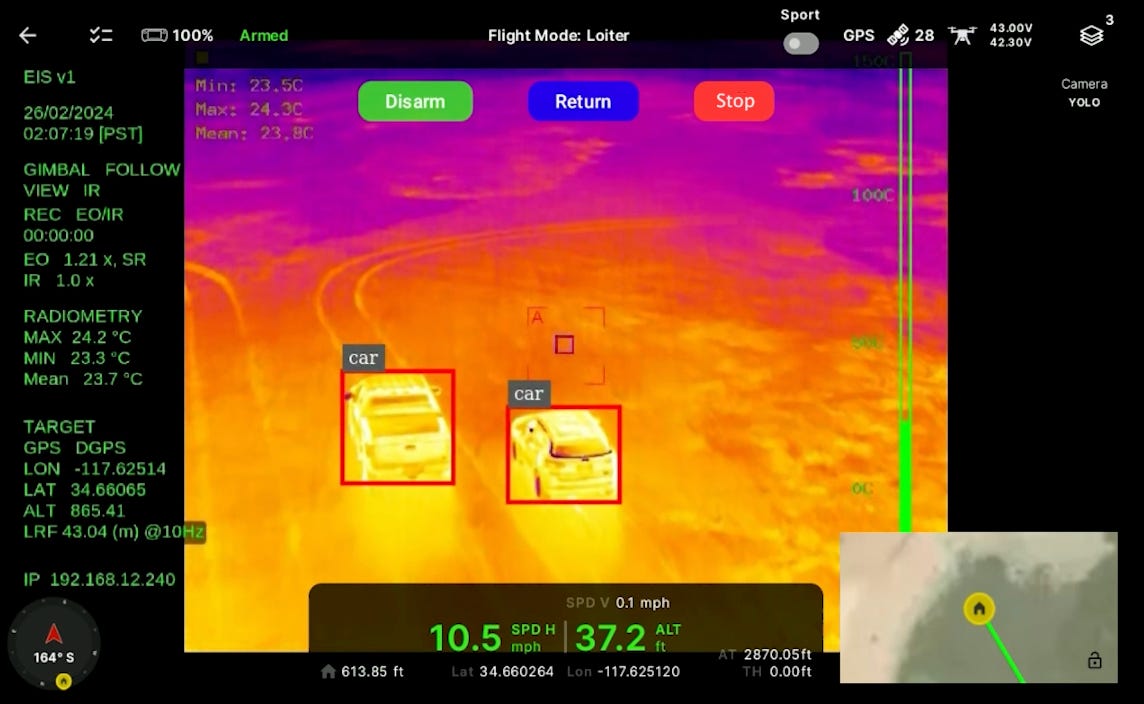
DJI alone supposedly has more than 100,000 developers building applications on its drones, mostly in China and on problems that no large company would pick up. The DJI ecosystem exists despite DJI not really making it easy. The hardware is largely closed. Onboard AI compute is minimal. Developer experience is an afterthought. The fact that 100,000 developers built on it anyway tells you what the latent demand looks like.
If that’s what is possible on closed hardware with poor tooling, imagine what happens when the platform is actually built for it. The ceiling on who gets to solve physical-world problems moves.
I recently sat down with Jason Lu, the founder of Flyby Robotics, to explore why this shift is happening and what opportunities this now unlocks.
The old market structure was a tax on distance
Physical-world problems have always been solved by whoever could afford to solve them, which mostly meant whoever could justify the cost of solving them at scale.
At the top, megacorps like DJI, Skydio, and Anduril picked off the problems large enough to move a multi-billion-dollar needle. Below them, venture-backed startups went after problems big enough to justify raising their next round of funding. Below them, smaller specialized companies went after the problems too narrow for the tier above. And below all of them sat people who actually lived the problems day-to-day, but got to solve essentially nothing.
Jason says this is because “the juice wasn’t worth the squeeze” for the people with the resources to solve them. Every layer of distance between the problems and the person with the authority to solve them acts as a filter. As Jason put it, “If you’re the 1,000th employee at Skydio, it’s unlikely you’re going to really care about these ‘small’ problems, like offshore oil rig corrosion or crop yield boosting 20% with multispectral imagery.”
Problems that aren’t big enough or profitable enough don’t get solved. This doesn’t mean those problems aren’t worth solving, it’s just that the unit economics of solving them has required a scale that most physical-world problems can’t reach.
This asymmetry has defined digital versus physical for a long time. Software ate the world. At first, it was mostly the parts of the world where one solution could be sold to millions of customers. But eventually with the app store and now vibe coding, anyone can build a piece of software to enable whatever problem they have, no matter how small.
This hasn’t yet been feasible for the physical world, but that is changing
Three things became true at the same time
What’s changing is that three independent curves are crossing at roughly the same time.
The first is compute on the edge. Until recently, you couldn’t put a lot of processing power on a small flying robot. “Imagine you’re trying to solve this for coding, but there are no computers. There are no servers. There’s no mouse,” Jason said. The drones Flyby Robotics are bringing to market carry 150 to 300 trillion operations per second of onboard compute, and in some cases even more. RAM is going from 2 gigabytes to 16 to, eventually, 128 or more.
Drawing on the iPhone analogy again, Jason said “the iPhone could only have happened because of advancements in RAM technology, in microprocessors, and in touchscreen technology. Those applications built on top of the iPhone were possible because these technical unlocks happened. That same transition is happening in the physical AI space.”
The second is abstraction over hardware. Controlling a gimbal or routing camera data into a model or deploying that model efficiently on a GPU – all of that used to require a specialist. There was no equivalent of an OS for physical AI, but that’s finally starting to change. Flyby for example is building the layer that lets a developer move a camera or a drone without ever touching the underlying SDK.
The third curve is coding agents. Claude Code, Codex, Cursor, and the broader category of AI-assisted development have dropped the skill floor for software work by an order of magnitude. Now everyone is empowered to describe what they want to build in natural language and AI will write the code for it.
Any one of these shifts on their own wouldn’t be enough. But the combination of capable hardware, accessible abstractions, and AI coding makes this possible for the first time.
The Opportunity
This changes what gets built.
The opportunity I’m most excited about is the platform that makes the long tail possible. This is both the hardware, and the developer layer that sits on top of it.
Right now you mostly can’t buy a drone or a robot with enough onboard compute to run a model that’s also open enough to add your own software. Solving this is a hardware problem that requires having the right chips, sensors, batteries, airframes, manufacturing lines, supply chains, and firmware.
Sitting on top of that hardware is the platform layer, which includes the abstractions, the developer experience, the model deployment tooling, the integration with coding agents. Without this platform, only specialists can use the hardware, and the ecosystem stays small. But with this platform, thousands of hyper-specific applications can get built by people closest to the problems.
This is the vision Flyby is pursuing in aerial robotics, and I suspect we’ll see others take on adjacent pieces of the work in different physical domains such as ground robots, underwater systems, manipulation, sensing. The shape of the opportunity is the same in each case: build the full stack that lets the people closest to a problem actually solve it, and capture value across the entire ecosystem of solutions that emerges on top of you.
The interesting thing about the App Store, in retrospect, wasn’t any single app. It was that the platform created the conditions for problems to get solved by the people who had them. Physical AI is approaching its version of that moment. The substrate is starting to come together and the distance between a problem and the person who can solve it is collapsing.
Author’s note: An LLM was used for light copy editing only (spelling, grammar, and clarity). Content, meaning, tone, and structure remain unchanged.