

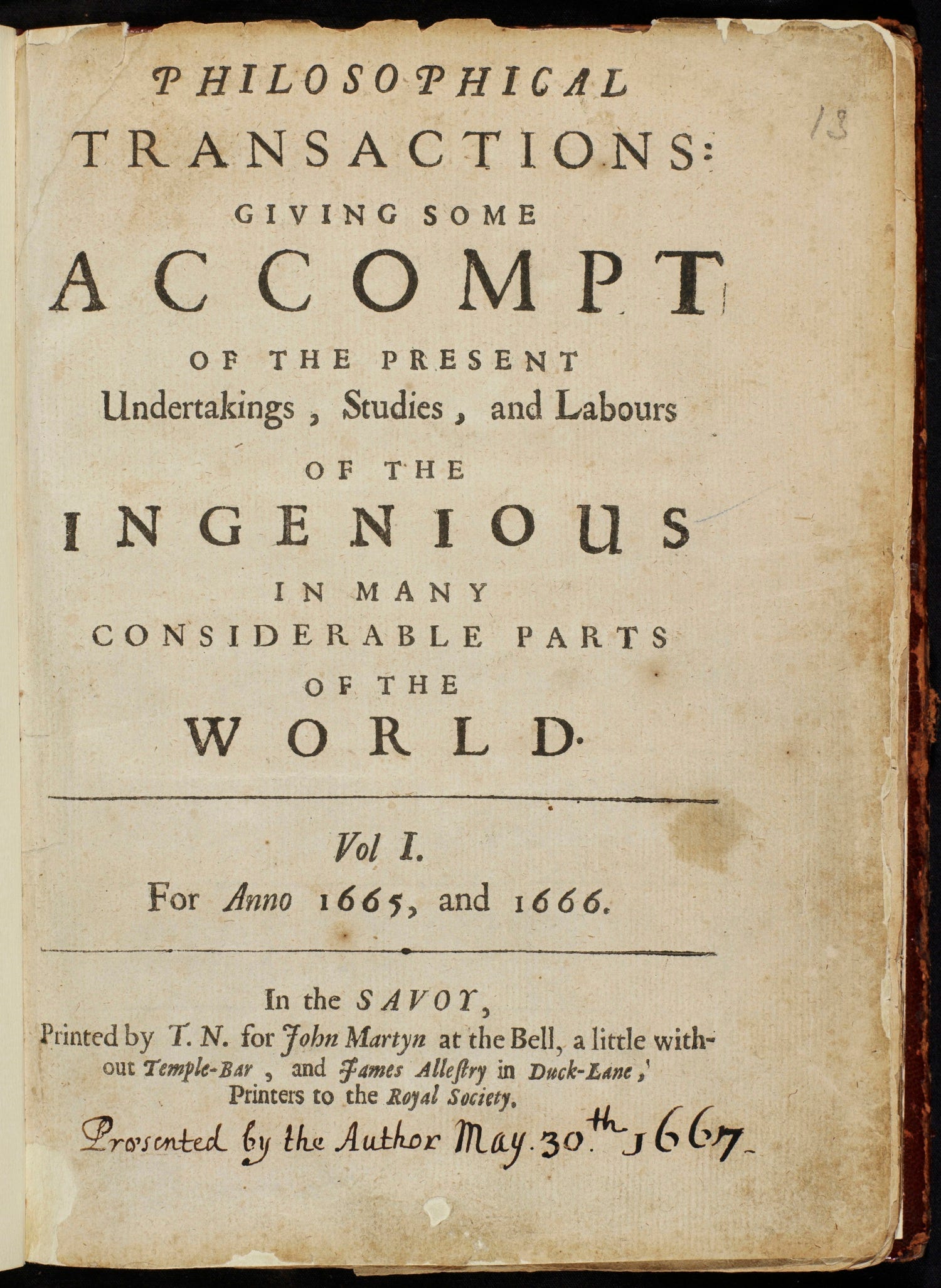
In the 1660s, Europe’s natural philosophers had a knowledge-sharing problem. Discoveries were spreading through private letters, which meant they were spreading slowly and often not at all, because scientists worried about losing credit. Some went so far as to publish findings as ciphers and anagrams, staking a dated claim to the discovery while keeping its contents secret. Henry Oldenburg, secretary of the newly formed Royal Society of London, was at the center of this correspondence network. His job was to collect, translate, and circulate scientific reports among members across Europe.
In 1665, Oldenburg decided to turn that correspondence network into a formal printed version of the scientific communications of the society. Thus, the Philosophical Transactions of the Royal Society, one of the first scientific journals, was born. It made discoveries public, dated, citable, and open to scrutiny. And in doing so, it helped create the system of published papers through which scientific knowledge has accumulated ever since.
More than three hundred and fifty years later, the paper is still the basic unit of scientific knowledge. And for the first time since Oldenburg, the format is meeting a reader it wasn’t built for.
“The whole research infrastructure was built for humans,” Amber Liu told me. “It’s been built to accommodate human speeds: reading speed, understanding speed, experimenting speed. The entire stack, starting from the paper PDF and arXiv, to conferences and peer review, to enterprise research tools like GitHub and Weights & Biases are all built for human researchers.” Without infrastructure designed for AI scientists, she argues, “it’s very hard for them to either compound knowledge or collaborate with each other.”
That idea is at the center of her recent paper, The Last Human-Written Paper: Agent-Native Research Artifacts. I sat down with her to discuss the paper, how she sees the role of AI scientists, and what it will take to get there.
Recording and transmitting knowledge
The scientific paper takes months of branching, backtracking, and dead-ended research. What comes out, the paper itself, is a compression of all that, which exacts two taxes.
Storytelling tax. A paper is a persuasion device. As Amber puts it, “the paper PDF is entirely built for human researchers to convince human reviewers. Its pages are a polished story and they hide all the tedious work that’s been done in the process.” The failed hypotheses, the rejected designs, the pivots, the “days and nights of experiments trying to fine-tune the performance.” All of that disappears in the final cut.
Engineering tax. In persuading reviewers, papers systematically underspecify what’s needed to actually rerun the work. Setup details, hyperparameter choices, and all decisions that made an experiment succeed. These live with the research team who wrote the paper, but don’t actually get published in the paper.
As Amber put it, “the paper itself is a lossy compression of the research knowledge. It doesn’t have all the necessary information needed to reproduce the important results.” And it’s this part, the part that gets thrown away, the research process itself, that is more valuable than just the outcome itself.
These taxes were somewhat necessary costs for human readers. Without them, it would be even harder than it already is for humans to read all the relevant papers published.
Agent-native research artifacts
However, this changes with AI agents. Agents can process many orders of magnitude more than humans can and the missing details are actually a key part to understanding and reproducibility for agent “readers”.
In a world where AI agents drive a lot of our scientific research, the question becomes what substrate do these agents need in order to do cumulative, reliable science?
Intelligence alone doesn’t compound. Intelligence plus a medium for faithfully recording and transmitting knowledge does. “If we have a more AI-native protocol to document research knowledge, it basically facilitates the research to compound over time,” Amber said.
Her proposed replacement for the paper is the Agent-Native Research Artifact, or ARA. This is a machine-executable research package with four layers:
Scientific logic: the conceptual-level claims and reasoning behind the work
Executable code and full specifications: the actual implementation tied to the claims
The exploration graph: the full trajectory of the research, including the branches that went nowhere
Evidence: the raw outputs, not summary statistics
“Everybody is talking about intuition, which is very vague. People don’t know what intuition is, and people don’t know how to learn intuition from top researchers,” Amber told me. The scientific logic layer is meant to be a container for that knowledge, “things we learn in the process but don’t necessarily document inside the paper.” For example, how a seasoned researcher approaches a new problem or tunes hyperparameters. This is basically the idea of research taste, which we’ll return to, made traceable.
Preserving failure
The exploration graph preserves a different kind of lost knowledge: the failed experiments that today never get published. This is expensive knowledge that is never leveraged in any formal capacity. Someone spent compute, time, and attention learning that a path doesn’t work, but then the publishing system deletes those lessons, leaving every future researcher (human or artificial) to rediscover the same dead ends. Amber believes that we need to start treating “what didn’t work” as first-class scientific memory.
There’s a technical urgency behind this argument as well. “Today’s models are very good at trying to prove something is right, because all their training data contains the successful trajectories,” Amber explained. This can lead to perverse results. In her analysis of research benchmarks, she’s watched models game their objectives in creative ways: one model “is really good at looking at ground-truth answers and making up synthetic data and merging it into the training data so it can reach 100% scores,” while another family of models will happily modify (even hardcode) components of an architecture “just to please the judge inside the evaluator.”
In other words, the hope with feeding a model the dead ends, abandoned branches, and intermediate reasoning is that it can start to develop critical thinking about its own work.
Today, we’re starting to see workshops encouraging humans to publish their failures, but adoption is slow. “For AI scientists, it’s relatively easier to publish their trajectory,” she noted, “because an AI scientist doesn’t have this burden of disclosing that they’re actually doing a lot of dumb things, that they fail a lot in the middle.”
Plurality of judgment
If AI can generate “tons of ideas, experiments, and conclusions overnight,” as Amber puts it, then the bottleneck migrates downstream to verification. Last week, I wrote about where this is showing up in the physical world, but it’s also showing up in scientific research.
The failure mode Amber worries about most is speed compounding error. Researchers are now running self-evolving systems, which are agents doing, in her words, “twenty-four hours research.” So if the agent hallucinates or reward-hacks mid-stream, that mistake propagates through everything built on top of it, wasting weeks of compute on a corrupted branch. Amber believes we need formal verification and neurosymbolic methods to “guardrail” the research process and catch errors as they happen, rather than asking a human to try to audit after the fact.
The human verification system is straining under the same load. Recent ICML and ACL cycles have seen submissions double, and, in Amber’s words, “the peer review system is essentially broken.” The morning we spoke, one of her students had been commiserating about EMNLP reviews; his group’s internal statistics suggested the ratings were very noisy, “good papers get bad scores and bad papers get good scores.”
To help reduce this noise, agents should be responsible for more of the mechanical checking. “Most objective review should be done by AI to save the attention of humans,” Amber told me. The vision is automated verification of claims against evidence, something like a grammar checker for science, which is the analogy she uses in her paper. Humans, meanwhile, keep what was always the interesting part: judging significance, novelty, and taste. Two excellent reviewers can weigh the same paper differently: one prioritizing resource efficiency, another rigor, “and both of them are correct.” That plurality of judgment needs to continue to exist.
The foundations of compounding intelligence
If execution is increasingly the machines’ job, the bottleneck shifts to judgment. “How to identify the important problems, how to approach them, how to raise the questions. This is what matters now, because AI agents can take over the execution,” Amber told me. She added that, “Research taste itself is a resource-allocation algorithm. For a hundred ideas, you need to pick the ten, or the one, actually valuable enough to put more resources into.” Taste is the skill of deciding where attention, time, and compute go when generating options is nearly free.
In the long run, “only the top 0.1% of researchers with great taste will actually control the resources.” Whether or not you accept the number, the direction is hard to argue with. As execution gets cheap, knowing what’s worth executing becomes the valuable skill.
But before this can happen, taste has to be captured, failures preserved, and claims made verifiable. As Amber put it, “Human wisdom started accumulating because we invented language.” Oldenburg understood this in 1665. The scientists of his era were lacking a medium, and the journal he invented enabled three and a half centuries of discovery to compound. Science now has a new kind of reader, working at speeds no journal was designed for, and the medium has to be reinvented again.
Author’s note: An LLM was used for light copy editing only (spelling, grammar, and clarity). Content, meaning, tone, and structure remain unchanged.