


Google, Google DeepMind, and MIT FutureTech recently published a study, AI in Science: Early Insights, to understand AI’s impact on science so far. The study looked at a corpus of 15M Gemini interactions, 2,690 specialized models, and a survey of 637 US and UK researchers. In the study, researchers report saving ~7 hours a week using AI, but nearly half reported a growing backlog of untested hypotheses.
In other words, as I wrote about here, AI is speeding up individual research tasks, but the overall process of turning predictions into validated discoveries is still constrained. This is the gap between what we can design or predict and what we can actually validate.
I sat down with Mihai Codreanu, a Google senior research economist who co-led the study. His interest in science stems from his interest in economic growth. “A big part of why economic growth happens is innovation and scientific discovery,” he told me. “If AI pushes science, it will also be pushing economic growth.”
But measuring that impact requires looking beyond the tasks where researchers already find AI useful. As Mihai put it, “discovery is still constrained by the types of tasks that AI may not yet be very good at.”
In our conversation, we unpacked the results from the study to understand where the bottleneck is today, how that is evolving and what impact this has on scientific research more broadly.
The bottleneck moves downstream
There’s a big difference between having more hypotheses and having more discoveries. “The micro level impact seems to be clear, scientists find AI very helpful in certain aspects of their jobs,” Mihai said. “But in order to see very big impacts on macro level discoveries, we have to think of all the other things that are within the scientist workflow and outside of the scientist workflow that need to happen.”
Nearly half of participants in the study said their main bottleneck had moved downstream over the last two years. Nearly a quarter said their constraints were in physical experimentation and/or data collection, closer to ⅓ for participants from physical sciences and engineering.
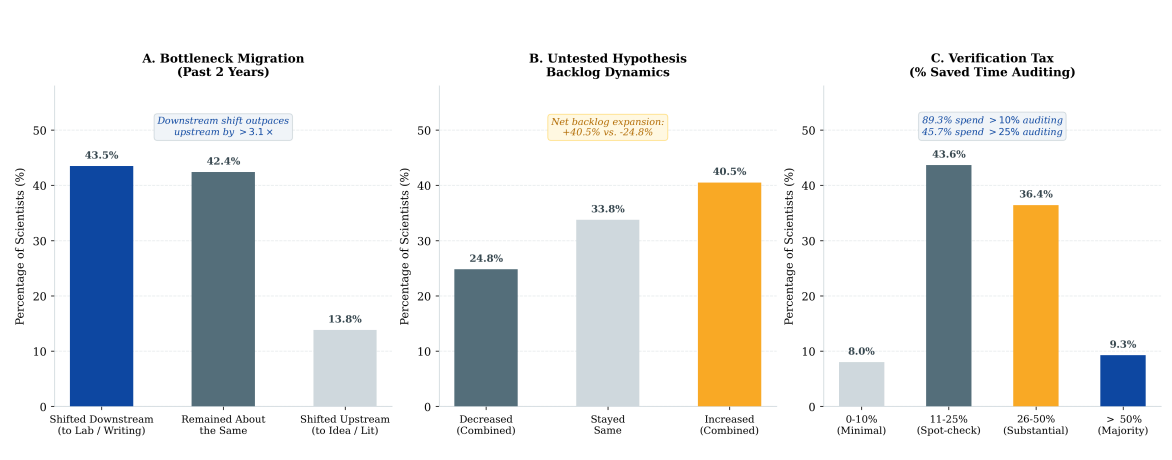
This implies that AI will accelerate discovery faster in fields where hypotheses can be tested computationally. “Computational fields can close the entire loop in silico, without leaving the digital environment,” Mihai said. But even those fields have constraints: access to compute, the cost of large simulations, and high-quality data and benchmarks.
And in every field, there’s a downstream cost around verification, which requires researchers’ active participation.
The verification tax
Mihai said one of the findings that surprised him most was “the sheer size of the verification tax.” 88% of scientists reported spending more than 10% of their saved time verifying AI outputs; nearly half spent more than a quarter of it. “AI is giving these productivity benefits, but there’s also the cost of verifying outputs,” he said.
What verification means depends on the field. In math or computer science, it’s reviewing code or a proof. In health and life sciences, which reported the highest share of saved time spent on validation, it means testing in a wet lab. In physical domains, the verification tax and the downstream bottleneck are the same thing: checking the model’s output is the experiment.
And Mihai doesn’t expect the tax to completely disappear as models improve. “Things like clinical testing or experimental replication, as well as expert judgment are core to the scientific method,” he said. “So even if models get very good, we’ll still need humans to validate them, at least in the short and medium term.”
Choosing what to test
“We don’t specifically look at the quality of these hypotheses,” Mihai told me when I asked about how we know how high quality this backlog is. But he suspects they are likely plausible enough to investigate and thus added to a queue. “At least for now, it seems that many of these hypotheses being reported by scientists are worth considering.”
For a lab with limited experimental capacity, an expanding list of plausible ideas creates a selection problem. Researchers have to decide how to prioritize experiments and when to abandon a direction.
“I am bullish on AI being able to help with this,” Mihai said. One potential path he described was around scoring frameworks that evaluate different hypotheses based on a variety of factors, such as feasibility, novelty, and expected value.
The hard part is deciding what to optimize around. For example, feasibility vs expected value. One hypothesis might be easy to test but scientifically incremental whereas another might be much more uncertain (and expensive), but potentially a lot more valuable. Choosing between this tradeoff means using judgment about what the likely result will be and its impact.
“The collaboration between human scientists and AI is going to be key,” Mihai said.
The pull toward safer questions
One of the more interesting tensions in the research concerns the questions scientists choose to pursue. The majority of respondents reported greater access to insights from other disciplines, and greater ambition and broader research agendas. But at the same time, about half of respondents also said AI encouraged safer projects in their own work. In other words, AI is making it easier to do more obvious work, faster.
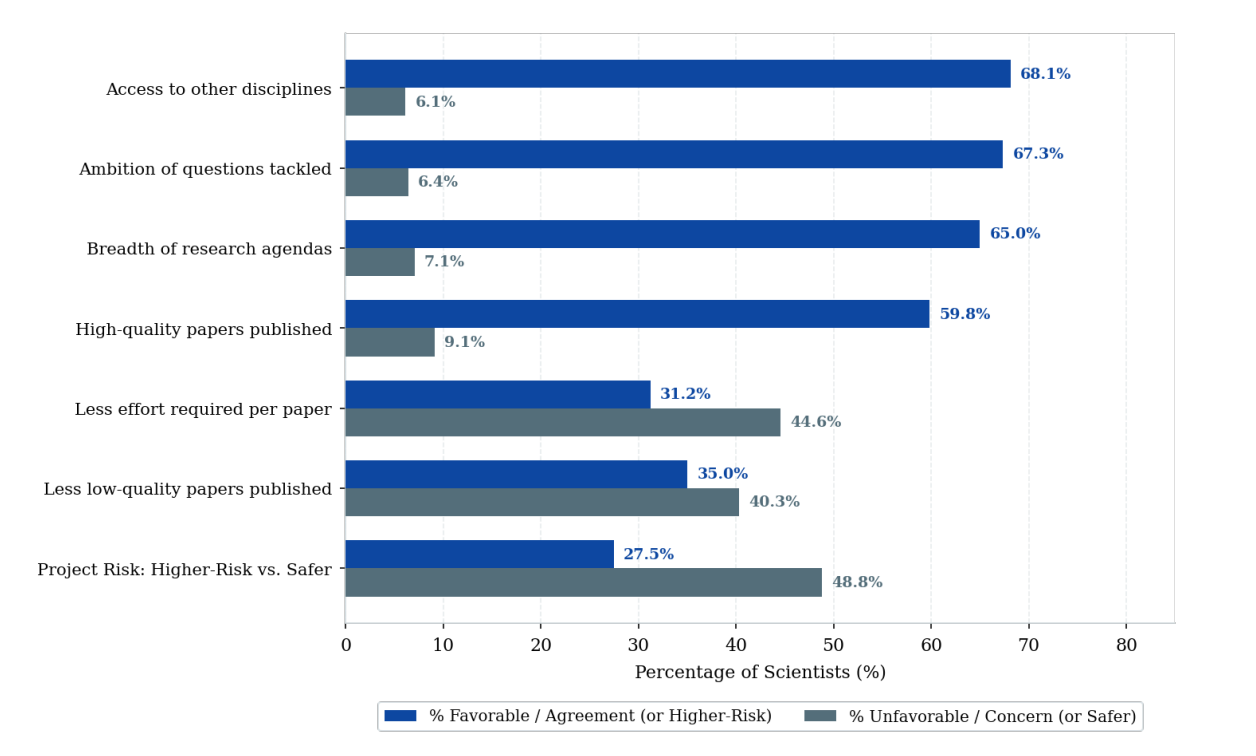
Mihai described two effects happening at once. “At the field level, AI can help scientists synthesize literature across disciplines,” he said. “And this could inspire a broader research agenda and a more ambitious vision.” For example, a researcher could more easily discover a method from another field and then connect that seemingly separate idea with their own work. This expands their view of what’s possible.
However, the other side of this is that when it comes to choosing a project, researchers will likely be most drawn to problems that already have a well-established corpus of data. “AI may lower the cost of tackling well-defined, data-rich problems that we have good data for and good benchmarks for,” Mihai explained, encouraging “lower-risk, highly achievable projects.”
He described this as a possible “streetlight effect,” which is the tendency to investigate what’s easiest to study, like looking for lost keys under a streetlight because that’s where you can see. In this context, AI may steer researchers toward questions with abundant data and established benchmarks, even when harder-to-study questions could be more consequential.
The concern is whether the ease of pursuing incremental work starts to steer the research agenda away from riskier, more novel questions. Mihai wants to better understand how the decisions around research topics accumulate over time. “We’re sort of thinking of this as measuring citation dynamics over time,” he said. This means tracking where major breakthroughs show up and whether diversity across research subfields expands or shrinks.
After all, this selection process shapes which ideas get explored and which have a chance to become discoveries.
What counts as scientific progress?
Toward the end of our conversation, I asked Mihai what would convince him that AI had enabled discoveries that otherwise would not have happened, or would have taken much longer.
“I would want to see more longitudinal data,” he said, pointing to high-impact findings and nonstandard breakthroughs. “I’d also look for proof AI is helping genuinely novel types of discoveries,” he added. To do this, you need to follow what happens after an initial result to understand whether other scientists find it useful, and if it opens new directions of research.
Mihai added that “it’s perhaps not enough to be correct. It also really matters how you are able to interpret and what you’re able to learn from these sorts of findings.” The value of a finding can extend well beyond the question it originally answers. For example, it may give researchers a new method to work with or a reason to explore a new direction they hadn’t ever considered.
He gave the example of AlphaGo’s “Move 37” in its 2016 match against Lee Sedol. “Those types of very creative moves are where I’m most excited about the potential impact of AI,” he said. In science, getting there requires having the capacity to recognize an idea’s potential and then test it.
“The promise of AI in science is that eventually we’ll be able to make those types of moves that are incredibly creative, that go beyond the limit of what human minds or researchers have tried on their own,” Mihai said. That’s the promise of AI for science, and it depends on what happens after we have a hypothesis.
Author’s note: An LLM was used for light copy editing only (spelling, grammar, and clarity). Content, meaning, tone, and structure remain unchanged.